My Brain’s Under Renovation—


I’m currently in the process of rewiring my TBI‑affected brain — which, frankly, feels a bit like trying to update a 1998 operating system using a hand‑crank generator. But here I am, diligently cultivating new synapses and building the cognitive reserve I’ll need to outrun the long family line of Alzheimer’s and dementia that’s basically waiting for me like a surprise party I never asked for.

For those of us blessed with a high‑octane, Type‑A monkey mind, the challenge isn’t just memory retention. It’s the relentless internal chatter — the mental equivalent of a toddler with a tambourine — that keeps the brain stuck in a low‑grade stress loop. My goal is to slow that down, literally and figuratively, by using the physical act of cursive writing to drag my brain out of its frantic autopilot and into something resembling deliberate, structural growth.


Why Cursive? Because My Brain Apparently Needs Handwriting Therapy

Cursive isn’t just “fancy handwriting.” It’s a neurological workout disguised as nostalgia — and the science backs it up.

A 2024 high‑density EEG study found that handwriting (but not typing) activates widespread brain connectivity, especially in theta and alpha frequency bands, which are essential for memory and learning.
🔗 Van der Weel & Van der Meer (2024):
https://www.frontiersin.org/articles/10.3389/fpsyg.2024.1333250/full (frontiersin.org in Bing)

  • Bilateral Brain Activation:
    Cursive requires continuous movement, forcing the left and right hemispheres to communicate across the corpus callosum — something my brain, like many brains, doesn’t always do unless bribed.
  • The Power of the Flow:
    Cursive mimics how thoughts should move: fluidly, not like a bullet‑pointed grocery list written by someone who forgot why they walked into the kitchen.

And this isn’t just about aesthetics — handwriting is increasingly recognized as a sensitive marker of cognitive health, especially in aging and neurodegenerative conditions.
🔗 Frontiers in Aging Neuroscience (2026):
https://www.frontiersin.org/journals/aging-neuroscience (frontiersin.org in Bing)


Why 20 Minutes? Because That’s When My Brain Finally Stops Arguing

Neurologically, 20 minutes is the sweet spot.

  • The 5–7 Minute Shift:
    It takes that long for my monkey mind to stop screaming about laundry, emails, and the existential dread of “what was I supposed to be doing again.”
  • The Plasticity Window:
    Once I hit flow, the next 13–15 minutes are prime time for building new neural patterns — without tipping into the fatigue spiral that TBI brains know all too well.
  • Consistency Over Heroics:
    Twenty minutes is doable even on days when my brain feels like a browser with 47 tabs open and one of them is playing music but I can’t find which one.

This aligns with research on cognitive rhythms and time‑blocking:
🔗 Ahead App Research — The Science of Time‑Blocking:
https://www.ahead-app.com/blog/the-science-of-time-blocking (ahead-app.com in Bing)


The Warm‑Up: Two Minutes of Drawing Infinity Like I’m Summoning a Portal

Before journaling, I warm up with two minutes of continuous figure‑eights.

  • The Drill:
    Fill a page with looping infinity symbols without lifting the pen.
  • The Goal:
    This “synaptic reset” quiets the monkey mind and preps the motor cortex for the sustained, fluid motion of cursive — like stretching before a workout, but for your neurons.

The “Anthropologist from Mars” Inventory: Because Humor Is Cheaper Than Therapy

Writing factually shifts processing from the amygdala (panic HQ) to the prefrontal cortex (the adult in the room). But pure clinical detachment can feel robotic, so I add humor.

The Prompt:
Write 10 lines describing your current activity as if you’re an alien researcher observing a confused human.

Example: “The subject is staring at a glowing rectangle while consuming a heated liquid stimulant. The subject is aware of a laundry pile nearby but is ignoring it with impressive determination.”

This technique is supported by research showing that externalizing thoughts reduces default mode network activity, which is responsible for rumination.
🔗 Neurosity — Journaling and the Brain:
https://neurosity.co/blogs/news/journaling-and-the-brain-how-writing-helps (neurosity.co in Bing)

Why This Works

  • Third‑Person Distance:
    Calling yourself “The Subject” creates psychological space from stress.
  • Humor = Cognitive Cross‑Training:
    To find the funny angle, your brain must shift perspectives quickly — a high‑level cognitive skill that builds resilience.

The Cursive Practice: Satire Meets Motor Cortex

Now combine the humor with exaggerated cursive.

  • The Drill:
    Write your alien observations in long, sweeping, dramatic cursive — the kind of handwriting that would make your third‑grade teacher weep with joy.
  • The Technique:
    When you get clever, you’ll want to speed up. Don’t. Slow down and make the loops even more ridiculous.
  • The Goal:
    You’re training precision and creativity simultaneously — the neurological equivalent of juggling while doing squats.

And yes, handwriting is increasingly being studied as a preventative tool for Alzheimer’s, thanks to its multi‑sensory, motor‑cognitive demands.
🔗 Atena Editora — Cognitive Benefits of Handwriting:
https://www.atenaeditora.com.br/post/artigo-beneficios-cognitivos-da-escrita-manual (atenaeditora.com.br in Bing)


So… Is This Sustainable?

Honestly, yes. It’s structured enough to work on your busiest days, playful enough to keep you engaged, and scientifically grounded enough to satisfy your inner researcher. Plus, it gives your monkey mind something to do besides narrate your to‑do list in a panicked whisper.


Camping & Exploring the Painted Rock Petrogylphs

paintedrock

If you have been following us, you know we put our home in Bend for rent for a year and have moved in our 2020 Winnebago Boldt for the year and if we like it or not this is our home until March 26, 2021.  So it has been a little over a week and a half since everything began closing down all over the country due to COVID-19, while we already started our one year trip visiting all the National Parks. We headed out of Bend, OR on March 1st where everything was okay and the world was functioning like whatever was everyday normal as we knew it as Americans.

Since then, we were able to visit the Lava Beds National Monumnent, Eagle Lake, Washoe Lake, Travertine Hot Springs, Alabama Hills, Death Valley National Park, Mojave Desert National Monument and Joshua Tree National Park. (More videos and blogs to come regarding each spot.)  While in Joshua Tree, state parks and national parks across the country began to shut visitor centers and some campgrounds. Many have now waved their frees and you can visit but there are no services. We have decided to go to places where they are in BLM or National Forests where there is free dispersed camping and you are well away from other campers.  We have a Pacific Pride Cardlock to fill at commercial diesel gas stations, so no interacting with people.  The only place we have to interact is grocery store which we try to only visit once a week or less.  We are trying to utilize the Walmart Grocery free curbside pick up service, but seems like everyone is doing that too.  When in a grocery store I am using gloves, distancing myself 6 feet from other shoppers, using the self-check out and going at times where there are the least amount of people.

So far we are still able to camp.  We were at Truckhaven Palm Wash BLM area and met a super nice local who wanted to make sure we weren’t stuck without resources.  Don’t worry we social distanced ourselves- him being outside our rig and us inside talking through the window.  Mike offered us ideas on nearby places of interest, where to dump and fill our RV if we needed it.  After Truckhaven, we headed to the BLM Pilot Knob Long Term Visitor Area, where it is free camping for 14 days and you are at least 500-1,000 yards from another camper.  This is different than Imperial Sand Dunes where there are a lot of RVers that are very close to each other, we would not recommend that area.  Today we arrived at thePainted Rock Petroglyphs, which are super cool. There are very few people here and social distancing is keeping us about 500 yards from other RVers.

sunsetpaintedrock

The Painted Rock Petroglyph Site is located on the eastern edge of the Painted Rock Mountains and about eighteen miles west by northwest of Gila-Bend, AZ. (information pulled from Wikipedia and BLM websites) The area is mostly flat and sandy with May-Oct daytime temperatures in the 100s. While we were here it was in the mid 70s in end of March.  The annual rainfall is only about six inches and the nearest irrigation water is the Gila River. In prehistoric times the Gila flowed west out of the mountains of western New Mexico, made a big dogleg turn at the town of Gila Bend and continued west to empty into the Colorado River. The Hohokam people once lived and farmed here. Ruins of their late Pioneer Period (AD 350 – AD 550) and Early Colonial Period (AD 550 – AD 700) villages are found to the north and west, and ruins of their Sedentary – Classic Period (AD 900 – AD 1400) villages are found to the south and east.  Over forty petroglyph sites have been recorded in the area, however; most of these sites are small with only a few dozen petroglyphs. The Painted Rock Site is the largest known site with about 800 images. While on my exploration I had the entire place to myself and did not cross anyone else.  Tomorrow I am heading out with Greg and Bode to hike on the historic Butterfield Overland Stage Route this was the old Oxbow Route that had mail travel from St. Louis to San Francisco back in 1858.

I recorded a short video for you to do a virtual tour and create activities for your children while they are off from school.  ( I have had requests from friends to do these little virtual tours).  I hope you enjoy it.  Keep checking back to our blog as we keep you up to date on how our  travels are going during this time and what you can and can’t do if you are a full-time RVer in the USA right now.

Celebrating International Women’s Day

Raneheadshot2014 Despite all the efforts, wide gender imbalance still exists in innovation worldwide, with number of women in science, technology, engineering and math (STEM) fields decreasing from secondary school to university, laboratories to teaching, and policy making to decision making.

At the same time, most developed countries are forecasting an alarming shortfall in the number of skilled people to fill these jobs. The International Telecommunications Union predicts that 90 percent of future professional positions will require information and communications technology skills as well as a solid background in science or technology. Developing women’s competencies will widen the pool available to perform these tasks, while opening opportunities for women to pursue their dreams.

iwdThis is why Microsoft believes in the importance of diversity to drive innovation and the need to enable women all over the world to become producers of tomorrow’s technology. I am excited to join Microsoft executives Lori Forte Harnick and Margo Day, as we partner with U.S. Chamber of Commerce Foundation’s Corporate Citizenship Center, United Nations Office for Partnerships and UN Women, for the 5th Annual International Women’s Day Forum: The Empowerment Bridge: Building Economic Empowerment for Women and Girls, held in New York City Wednesday and Thursday.

This event is particularly important to me, being a first-generation Vietnamese American. I was an immigrant at-risk youth who was emancipated at age 14. It was an interest in science, engineering and technology that helped me grow out of poverty and become a leader in the field. To see young women around the world embrace this field and create solutions that will make a difference inspires me every day and excites me to represent Microsoft as we partner with amazing organizations to enable every girl in the world reach their full potential.

I am excited to work with Lori, who leads Microsoft’s global work on corporate social responsibility as general manager for Citizenship & Public Affairs. She will kick off the event with Marc DeCourcey, vice president of the U.S. Chamber of Commerce Foundation, Corporate Citizenship Center. Personally and professionally Marc has seen how lives and entire communities are transformed when women are empowered. Through his work with the Red Cross and currently with the U.S. Chamber of Commerce Foundation, he understand the value of business, nonprofits and governments all coming together to improve lives.

Lori’s passion to help students all over the world makes her perfect for this event. Not only does she lead Microsoft’s social responsibility and service, legal and public policy arm, she serves on a number of boards and an advocate in the community. I love that she is an active volunteer for Global Give Back Circle, which integrates mentoring, private sector engagement, government and local community support to help at-risk girls in Africa complete their education, gain employable skills and transition into the workplace.

Lori will be speaking about sustainable development goals and the role of the business community during a panel Thursday. She has been mentoring Egypt-born Raneem Medhat as part of Microsoft’s YouthSpark initiative. “She is a few months away from graduating university with a computer science degree,” Lori says of Raneem. “It is really interesting to work with her at this juncture in her life.”

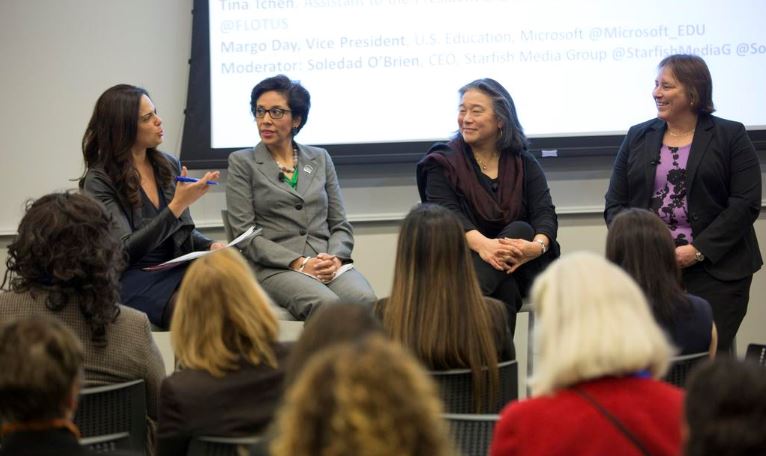
Also, as part of the event, Microsoft’s Vice President of U.S. Public Sector Education Margo Day will have a discussion about accelerating STEM education with Anna Maria Chávez, chief executive officer of Girl Scouts USA and Tina Tchen, Michelle Obama’s chief of staff. It will be an inspiring and action-filled session, with one of my favorite broadcast journalist Soledad O’Brien of CNN moderating.

Margo is perfect for this discussion not only because she is leading our work in education across the country, but in September 2011, she stepped away from her role at Small and Midmarket Solutions and Partners to focus her passion and energy on raising funds and awareness for the Kenya Vulnerable Girls Education Project and Child Protection, partnering with World Vision, an effort that built schools and deepened community advocacy for education.

We will end the day with a screening of “Big Dream” and a panel discussion with the director, and a student from the film, as well as partners UN Women and Global Girls Collaborative Project.

Underwritten by Microsoft, “Big Dream” follows the intimate stories of seven young women who are breaking barriers and overcoming personal challenges to follow their passions in science, math, computing and engineering. Much like International Women’s Day itself, the hope of the film is to show young women all over the world that computer science is creative, collaborative and impactful ― and they can be producers of the solutions that will solve the world’s greatest challenges.

Learn more on how you can enable women around the world:

Host a free screening: Big Dream Movement
Learn: Free CS online learning for girls
Find resources: UN Women Empower Women
Find STEM organizations near you: National Girls Collaborative Project, US Chamber Commerce Foundation
Watch the State Department’s American Film Showcase