New Year’s Resolution: I can’t do everything and that is okay!

Welcome 2021!  As we celebrate Martin Luther King Jr. Day today, I feel his quote is particularly fitting for this blog: ” Even though we face difficulties of today and tomorrow, I still have a dream.”

This week I am going to deviate slightly from van life travel.  After one year of retirement, touring the country– living in a van and experiencing life during a pandemic, I decided my New Year’s resolution would be that of being fully honest on my capabilities and accept I can’t do everything. 

Being a Type A overachiever, who believed and spent the last 40+ years if you put enough effort and determination you can do anything you want to try, it’s hard for me to now admit I am prohibited in doing everything.  Living with Traumatic Brain Injury (TBI), now makes it no matter how hard I try there are things I just can’t do anymore well.  TBI is a hidden or invisible disability I have been living with the last seven years.  Many people don’t realize what is an invisible disability, a physical, mental or neurological condition that is not visible to others because they can occur in life but the person does not outwardly appear to have a problem since there is no need for a wheel chair, walker or crutches.  After spending years multi-tasking, sitting on multiple global projects, advisory boards, commissions, tasks forces and doing it all successfully, empathetically, and professionally it’s hard for  people who have interacted with me, that I just can’t do those things well anymore.  When you have TBI your Amygdala and occipital lobe can be damaged.  Your Amygdala is responsible for many important brain functions like, memory, learning, executive function and emotions while the occipital lobe controls your visual processing, distance and depth perception, object and facial recognition and memory formation.  Due to my damaged Amygdala and occipital lobe:

  • I now forget a lot of things and need lists
  • If I am told something in confidence I may forget and discuss it
  • I no longer have a filter and say things I should know not to say that may hurt someone’s feelings (lack of executive function)
  • My emotions are constantly on over load,
    • I get overly upset if I hurt someone and can’t stop worrying about it
    • I anger easily over silly things
    • I am quick to cry
    • I am quick to yelling and raising my voice
    • I feel like I need to apologize to my husband multiple times a day for my behavior
  • It’s difficult when I drive, I must concentrate really hard due to my challenge with depth perception and reaction time has decreased significantly
  • I get migraines often, feel woozy and need to nap daily

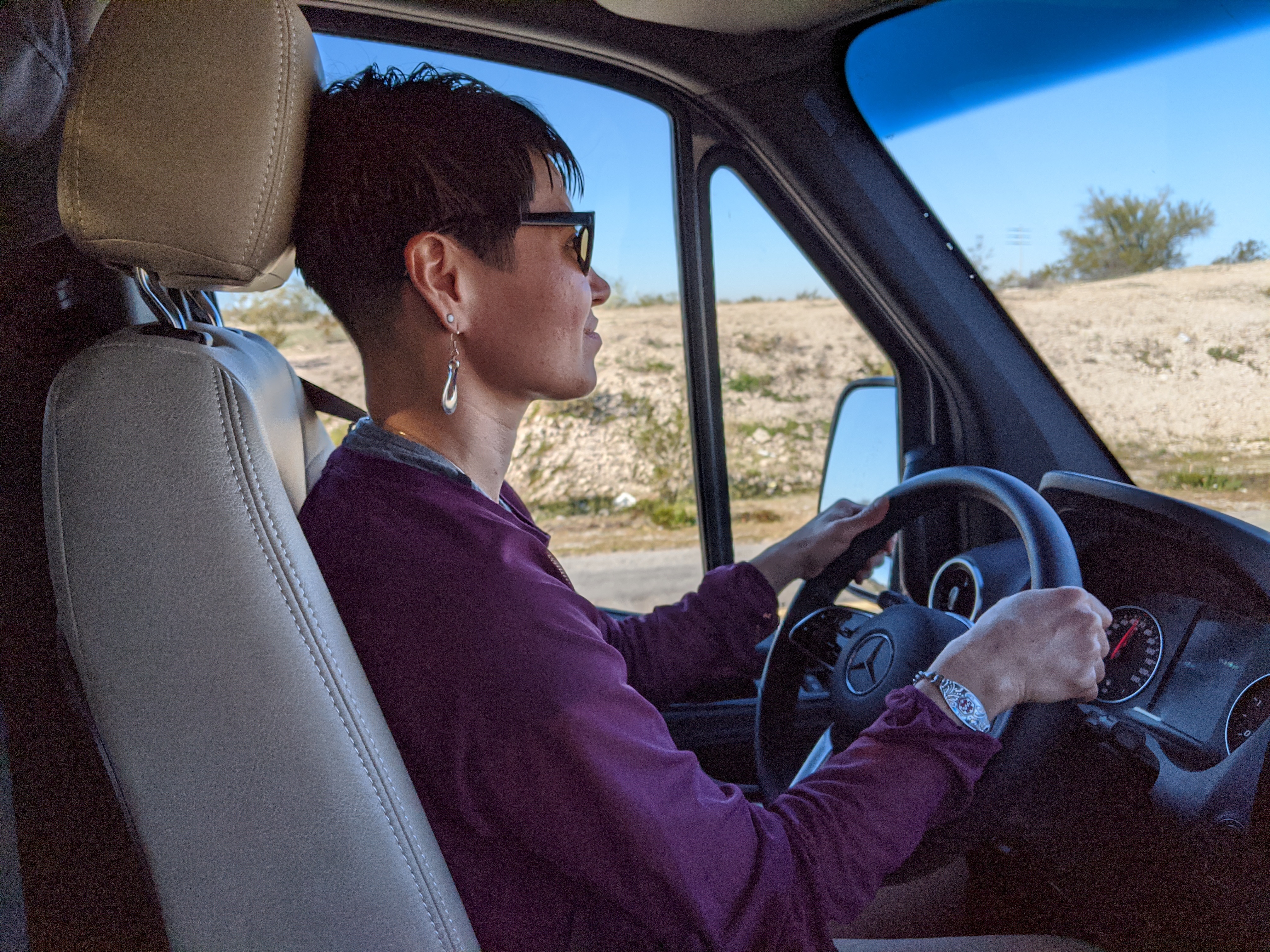
Because of this, I sold my business at the end of 2019 and retired.  I finally learned I couldn’t work anymore when I needed to nap daily, I’d get frustrated and set-off so easily, and if I had a hard day, I would be dizzy, nauseous and have a migraine.  So, Greg made the executive decision for us to hit the road and enjoy the vanlife and start RGBAdventures to document our adventures.  When you visit our blog, our YouTube, Facebook and Instagram it looks like all fun but you don’t see the tough days dealing with TBI.  In a social media world, we see all the positives and don’t share the challenges. It’s hard to be vulnerable when we live in a society that must show competence and achievement. 
I write this post for four reasons:

  1. To remind us that many people have disabilities and challenges that are hidden and we don’t realize and that we need to be more patient and understanding, especially in a time of COVID-19
  2. Don’t let social media get you depressed and feel like I wish I had that life, as that person probably feeling same challenges and difficulties as you but can’t really show it and wants to create positive influence in your day.
  3. If I personally hurt you by my actions, I am so sorry it wasn’t my intent and I can’t make TBI an excuse but hope it gives you some understanding to forgive me eventually.  And if you know someone who may have TBI please understand they may look normal but if they do something that upsets you try to understand that they may not have full ‘control’ of their brain anymore. 
  4. To remind myself and others that we can’t do everything and that it is okay to lean on friends, family and loved ones and admit when we need help.  I hope this also allows you to ask for help.

During this pandemic, we need to give ourselves and our community a break and be more understanding.  It’s okay for us to have a little more self-care and do a little less.  It is a great time to enjoy the outdoors and what mother nature can bring us to relieve anxiety and stress.  When I can’t control my brain, the one thing I appreciate the most living in a van right now and being able to control is being able to run, hike, bike, ski, paddleboard, swim and focus on my physical health.   It’s okay to be vulnerable, not be perfect at everything and let people help you.  If you want to learn more about TBI here is a great article.  Hoping for a positive and wonderful 2021 for everyone! 
The Joy of Art, Music, Crafting and Gifting to Heal the Type A Brain

After my seventh concussion and being diagnosed with Traumatic Brain Injury, as stated in my last two blogs, I began to take my injury more seriously and knew I needed to make a change in my life.  My emotions were on a roller coaster ride.  One minute I would be happy, then next my husband would say something and I was ready to pummel him in rage and then the next I would be crying hysterically like a toddler having a temper tantrum. Not only were my emotions wreaking havoc in my life but my memory, word searching, attention span, reasoning and problem-solving skills were like a child.

Since I had been told by my neurologist to not read, go online or watch TV, I needed to do something to occupy my time and get healthy.  To go from having 15 hours scheduled by the minute to no schedule was utter maddening.  You can only spend so much of your day meditating, doing yoga, going for hikes/walks and cooking. I was still struggling to occupy my days and I wasn’t ready to see very many people other than my closest of friends.  My godfather and mother came over for a visit and she taught me to knit. I became a knitting fool.  Making scarves, hats, shawls for everyone I knew.

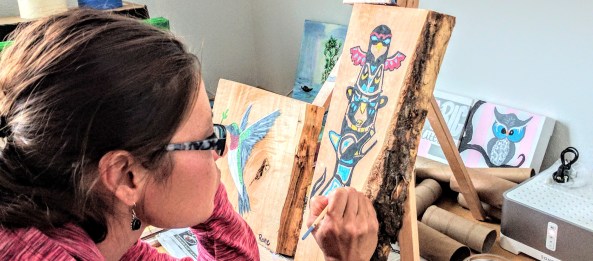
My sister-in-law gave me a nail art kit for my birthday and soon I was making everyone wood nail art deer, owls, ravens and landscape pieces.  I also thought it was time to do something with the bags and bags of wine corks I had collected and made these wooden and cork hot pot holders for dining room tables and cork boards. That Christmas everyone got a Rane original creation!  I was becoming a crafting aficionado and enjoying the smiles on people’s faces as they got something made by me.  I was getting a little over zealous with my knitting and I think I made everyone I knew something, that my husband suggested isn’t there other art therapies or maybe even music therapies I could try?

shawl

One of the many shawls I created for friends.

I then remembered with the work I was doing before I went on medical leave from Microsoft regarding helping military veterans reskill and get jobs in technology. There was research on art and music therapy helping military veterans with traumatic brain injury.  I thought if it could work for them, it may possibly work for me.  I couldn’t read the research reports to understand the details and unfortunately scholarly reviewed publications are not on digital audio yet, (perhaps, someone should really look into that.)  So, I went to my psychologist and asked what types of art and music therapy I should try. This would occupy more of my day, give my monkey mind a part-time job and hopefully start helping my cognitive impairments. He suggested I start first with the adult coloring books and listening to classical music.

Once, I was able to read again I began to learn what art and music therapy can really do for you.  In the last ten years, there has been significant progress in the study of TBI and art/music therapies.” Biomedical researchers have found that music is a highly structured auditory language involving complex perception, cognition, and motor control in the brain, and thus it can effectively be used to retrain and reeducate the injured brain.”

I also learned that listening to “polyphonic music has shown to engage neural circuits underlying multiple forms of working memory, attention, semantic processing, target detection, and motor imagery, in turn indicating that music listening engages brain areas that are involved in general functions rather than music-specific areas.”  A good example of polyphonic music is this old Sting classic, I love this YouTube rendition.

In addition to listening to music, I took it a step further and have been teaching myself to play the acoustic guitar. Through other books, I learned the importance of dancing and singing every day to my favorite song and how that help grow the strength in my vagus nerve (As my earlier blog stated, I learned my vagus nerve was having issues and was the reason for my blacking out and causing all my concussions and traumatic brain injury).

My poor husband would have to listen to me belt out at the top of my lungs ‘Dancing Queen’ by ABBA or ‘It’s a Beautiful Day’ by U2 or ‘Brown Eyed Girl by Van Morrison and the list goes on and on.  I started rubbing off on my friends and they would text me their dance out song of the day.  You should try it; your whole body get a rush of endorphins and total jubilation once your done with a grin a mile long and your spouse laughing hysterically at you.

IMG_20170504_142904 (2)

My first set of paintings on display at Chow Restaurant in Bend, Oregon.

I was starting to get bored with my adult coloring books from Costco.  When I was at the Newport Visual Arts Center, looking at the latest show there was a bunch of people painting with watercolors on the second floor.  As I walked in, I found out they had received a grant that allowed them to give free art classes every day for the community and I was invited in to try.  So for the rest of the Summer, every week I attended the water color class, pottery class, pastel class, coloring pencil class, and acrylic painting class. Soon, I was able to read again, I learned through Psychology Today that art therapists, “McGuinness and Schnur worked with TBI patients and they explain the salient roles of art therapy in addressing various parts of the brain with clients in a user-friendly way.”

They also state that, “art therapy can help with organization, problem solving, and memory when the frontal lobes have been affected by TBI.”  I then started concentrating on acrylic painting as my favorite form of painting.  And thanks to my friends Lisa and Amy, who one day said, “Hey Rane, you are actually getting good- you should sell your art!”  To my utter amazement, a local restaurant wanted me to show my art and by January 2018 I had sold 12 pieces.

Filling my days with painting, listening and playing music my energy, emotions and memory were improving. The hardest part of my TBI has been moving from a super positive always happy demeanor that rarely ever got mad to this uncontrollable rage that pops up from just a little comment could set me off.  If anything can calm this new emotion, I am happy to do it.  I am lucky my husband is understanding and can deal with these moments that happen several times a month.  My days are now packed with art, music, yoga, mediation and the outdoors. I highly encourage everyone, even those who may not have traumatic brain injury the power of adding more art, music or crafting in your life.  A lot of the research highlights how it can help slow and possibly stop Alzheimer.  Here are a few of my favorite beginner Youtube videos to get you started with music, art and knitting, I hope you try-  I promise you will have fun!


Learning mindfulness, mediation and tranquility

Through this ordeal I have learned a lot about concussions and traumatic brain injury. Every time I stress out and continue to blackout and hit my head, I could cause major neurologic and psychological problems. I finally took this seriously and decided I could not power on through.  In the next few paragraphs, I will give you a summary about stress, concussions and brain injury.  It’s a little dry taken from Mayo Clinic and a few other scientific publications but its helpful in your understanding why mediation is so important for those of us who are workaholics or survivors of traumatic brain injury.

Every year, 1.5 million Americans sustain traumatic brain injuries.  In a concussion, your neural cells are damaged and your brain must recover to rebuild these cells.  If you are always stressed your levels of cortisol will be high and the brain will take even more time to recover.  Cortisol is a corticosteroid hormone that is released by your adrenal gland during stressful situations. When your highly stressed then a large amount of cortisol remains in your brain. It generates more overproduction of myelin-producing cells and fewer neurons than normal. This can result in adverse effects that can impair important cognitive structures in your brain, like damage to your hippocampus (responsible for the processing and storage of short-term memory).  In addition, it affects the differences in the volume of gray matter versus white matter (creating more white matter and increasing atrophy in the white matter), as well as the and size and connectivity of the amygdala (is the integrative center for emotions, emotional behavior, and motivation).  The “gray matter” of the brain is densely packed with nerve cell bodies and is responsible for the brain’s higher functions, such as thinking, computing, and decision-making.

Multiple concussions reduce the amount of gray matter and decreases the number of stem cells that mature into neurons affecting learning, memory, decision making, multi-tasking and concentration. In post-concussion syndrome you can have symptoms like fatigue, sleep difficulties, irritability, balance and coordination problems, agitation, nausea, vomiting, dizziness, altered consciousness and difficulty processing information. I was suffering from all of these!  Studies and research have shown that Mindfulness meditation helps to reduce the symptoms and distress on the brain and helps increase gray matter in the insula, frontal cortex and sensory regions.  Researchers found that the frontal regions, anterior cingulate, limbic system and parietal lobes were affected during meditation and that there were different patterns of cerebral blood flow between the two meditation states i.e.“focused-based” practice and a “breath-based” practice.

Meditation increases regional cerebral blood flow (rCBF) in the prefrontal cortex.  As reported by researchers the cerebral blood flow of long-term meditators was significantly higher compared to non-meditators in the prefrontal cortex, parietal cortex, thalamus, putamen, caudate, and midbrain. In brief body-scans of meditators show meditation practice improves somatosensory perceptual decision making.  Meditation enhances cortical remapping and brain functions while it also helps to uplift mental health and causes healthy changes in the brain. It was time to take my meditation practice seriously!

So, for ten years I was trying to learn how to meditate but never had truly made a practice.  I had read a number of books on meditation, mindfulness and how to radiate calmness.  I even went to mediation workshops but I never stuck to it.  Now I had to or I may never get better.  In the beginning, trying to calm my monkey mind was impossible.  I would start focusing on my breath and then the next minute I would be thinking about what I would knit next, go back to my breath and then think about a new recipe to try.  I could never sit there for more than 5 minutes without having to twitch or move or scratch.

If you are a crazy Type A person, whose mind is always thinking and nerving on something.  The best way to get into a mediation practice is to start with guided meditation for sleep, called Yoga Nidra.  I started with this one and then later I downloaded the Insight Timer App from the Google Store, it is amazing and I highly recommend it. My first few weeks I focused on mediating for 15 minutes lying down in bed before sleep during my afternoon nap and right before bed. Your brain can much more easily focus on the voice.   Like what my favorite Tibetan Buddhist Meditation master: Yongey Mingyur Rinpoche says, “You must give your monkey mind a part-time job to be able to meditate.”  As I did these guided meditations, I began to really focus on breathing meditation.

So, a couple times a week before I got up to start my day, I would switch off my audiobook and focus on my breath.   I would chant in my mind rising and falling with the rise and fall of my breath.  When my mind would wonder to something I could hear I would chant hearing, hearing.  Then when it would calm I would go back to my breath and chanting rising and falling.  When I would feel my mind wandering and want to scratch or move my leg, I would start chanting feeling and I would then not need to move and then go back to focusing on my breath.  Soon I was building mindfulness and awareness.  Once again, I was only doing this for 10-15 minutes.  I could feel my energy increase, my twitching and constant need to move to slow.

I am also now enjoying chanting mediation called Om mani padme hum.  I took this from the Tibetan Culture website “Om mani padme hum, which is an ancient mantra that is related to the bodhisattva of compassion, Avalokiteshvara.  Every Tibetan child is taught the mantra by their parents, and they all use it very commonly in daily life, and especially if they make a prayer walk (kora) or go to the temple, or pray using a rosary (mala).  Basically, any mantra is “a sound, syllable, word, or group of words that is considered capable of ‘creating transformation.’”  There are great examples and guides on the Insight Timer App.

I then re-read all my meditation books, I highly recommend the following:

·         The Joy of Living: Unlocking the Secret and Science of Happiness, By Yongey Mingyur Rinpoche with Eric Swanson, Daniel Goleman

·         Joyful Wisdom: Embracing Change and Finding Freedom, By Yongey Mingyur Rinpoche with Eric Swanson

·         Turning Confusion into Clarity: A Guide to the Foundation Practices of Tibetan Buddhism, By Yongey Mingyur Rinpoche with Helen Tworkov, Matthieu Ricard      ranemediating

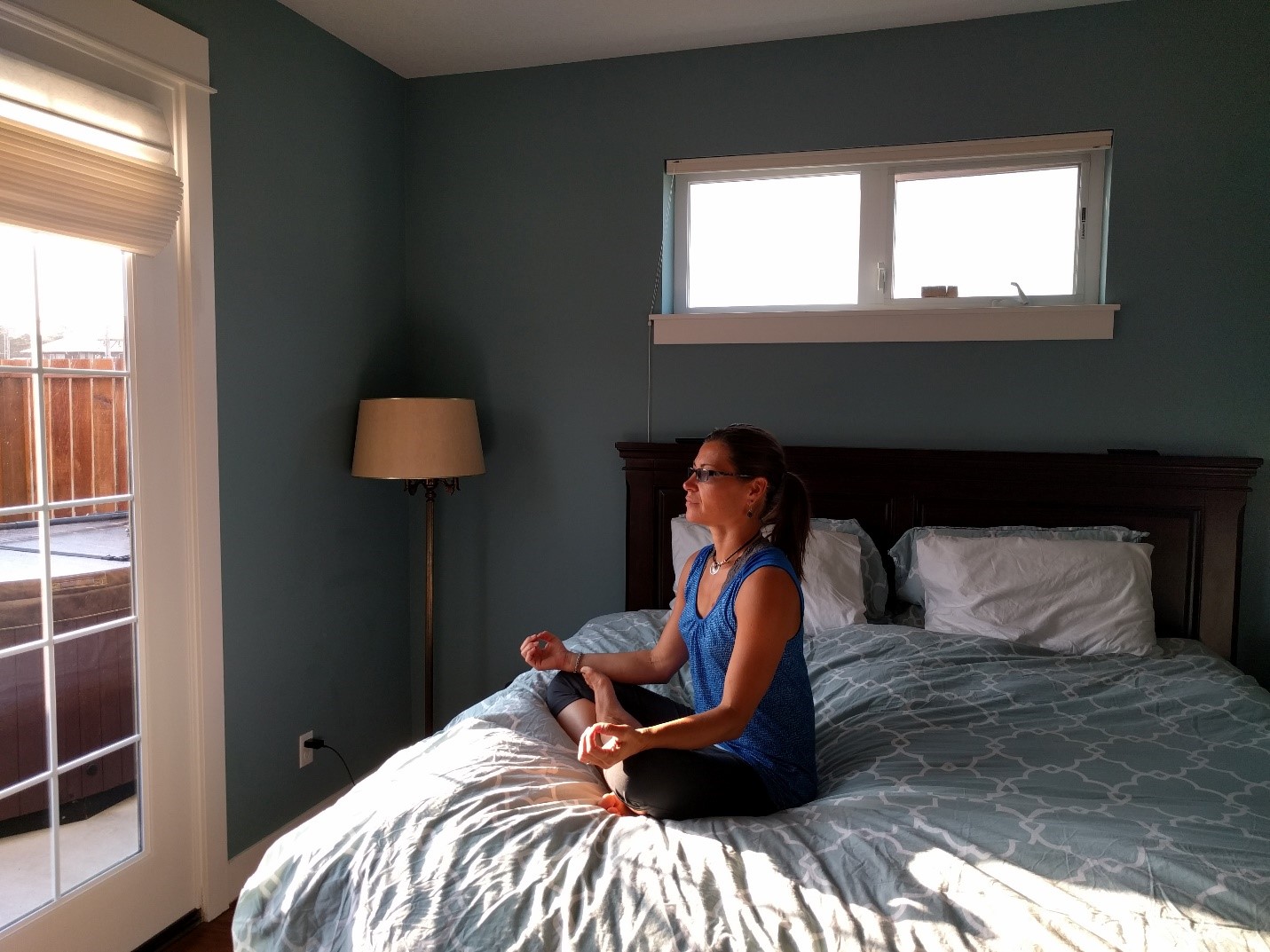
Rane mediating at our Beach House in Newport, Oregon

They now began to make more sense to me.  I now tried walking mediation when I went on my walks in Shevlin Park and around the golf course.  Trust me it’s not easy, I would have good weeks and have weeks in which I did no mediation and forgot about my practice.  But I wanted my brain to heal so I would then make sure even if it was only 5 minutes I did some type of mediation each day.  Then my friend Maribel taught me Hong Sau Mediation, which I love and can do for 30 minutes a day now.  I highly suggest this for beginners, here is a link to a great guide.

Today, I am focused on loving kindness and mindfulness mediation called Metta Bhavana.  In this practice, you start focusing on yourself and feelings of peace and calmness and then nurture your state of mind into strength and confidence while chanting ‘may I be well, may I be happy, may I be healthy and may I be free from suffering’ and cultivate the love within your heart.  The next stage you focus on a close friend.  Think about your connections, why you love this person, why you are encouraged by this person and begin chanting ‘may he/she be well and happy’ as you feel the love in your heart for that person grow.  Think of a person you are neutral with and have neither strong love or dislike for and think about this person’s humanity, what actions this person can make you feel encouraged and could make you love this person.  Begin chanting ‘may he/she be well and happy.’ Now think of someone you really dislike and have ill feelings toward (an enemy) and don’t concentrate on their negative actions but think about their positive actions, how can you think about the good intent he/she may have, how could you grow to love this person, how can you encourage this person and have good will towards this person.  Now chant ‘may he/she be well and happy.’ Lastly, in this practice you will think about all four people in positive light, now extend those thoughts to all the people you know, all the people in your neighborhood, all the people in your town, all the people in your region, all the people in your country, all the people and beings on earth.  Feel the love, encouragement, kindness you have for all these people.  Begin chanting ‘may all the people on earth be well and happy.  Slowly focus back on your heart and the love and kindness you are feeling and then step away from your practice.  This has grown into a 45-minute practice for me now.  Some great guides come from the buddhist centre.

My aspiration is for my experiences through mediation to help you in your desire to grow your meditation practice.  My greatest wish is this helps other Type A’s who feel: I really want to meditate but I just don’t have time or patience or the ability to focus their brain that way.  I am here to tell you, you can’t afford not to!  If you are a stress junkie like myself, you must start mediating ASAP you really want to repair the damage you are doing to your brain.   I am hopeful that this is helping my brain and in turn yours.  I am on twenty months of no blackouts and my migraines are diminishing.  I believe my memory is getting better.  I am also working much more on the right side of my brain with art, crafts, playing music but that is the next blog post.  Till next week, I hope you try a few of the practices above.