Visiting Dinosaur National Monument

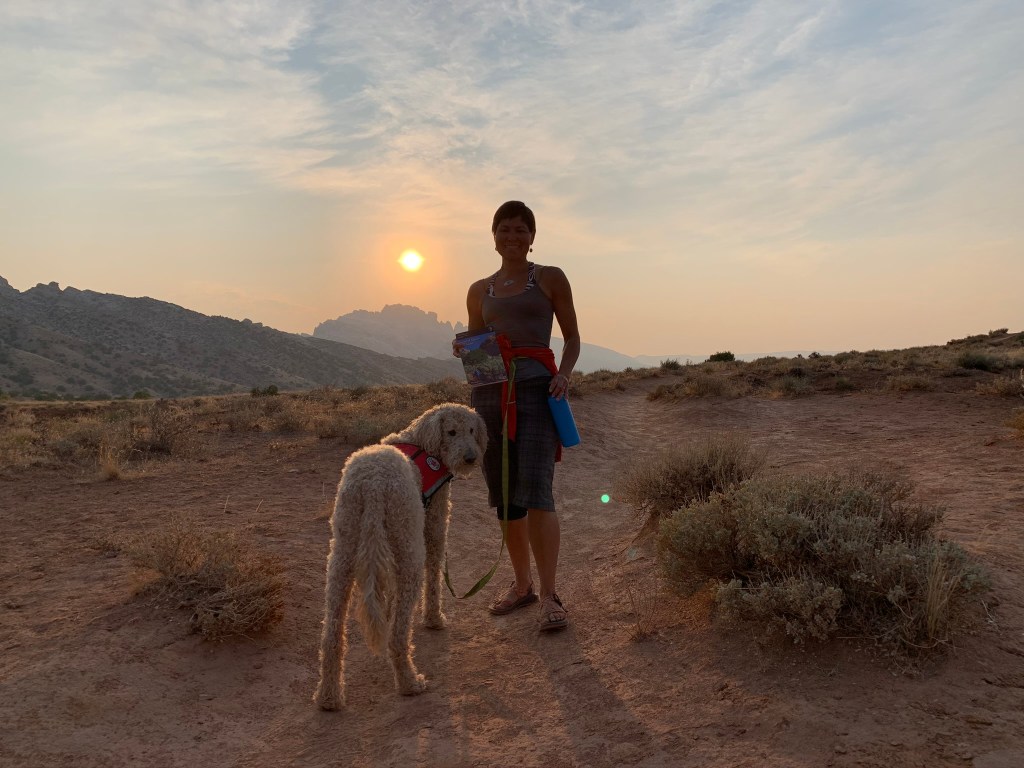
RGB Adventures visited Dinosaur National Monument on the Utah and Colorado border.  This was one of my favorite monuments I have visited so far in the last six months.  We spent three days in the park and we still did not have a chance to explore the northernmost areas of the park and missed the Gates of Lourdes…something for next time.  Perhaps because of Covid19, it was the least amount of people we have come into contact with in the national parks and monuments.  It was wonderful to have so many hikes and opportunities to visit petroglyphs by ourselves.  I highly recommend getting the first 9am appointment at the quarry and doing hikes by 7am.  Most people are not out and about yet and the sun isn’t beating down on you.  Also, the rangers still are excited to answer questions!  The temperatures are more in the 70s instead of the 90s. 

This blog and video are dedicated to the members of the National Girls Collaborative Project.  When I worked for Microsoft, I had the opportunity to join the champions board and volunteer for the organization for the last 10 years.  As many who know me are aware, I am passionate about encouraging women to undertake careers in engineering and STEM and that is what NGCP is all about with an amazing leader and great friend Karen Peterson!  I hope this blog excites girls to consider careers in the environmental sciences!

We started off by entering at the Jensen, Utah gate and went to our campsite at Green River Campground.  There were several first come first serve sites there so we did not have to make a reservation.   The next day, we got up early in the morning to hike through several petroglyph sites, enjoyed the amazing rock formations at the Sound of Silence 3.2 mile hike and instead of taking the tram we did the 1.2 mile one way discovery fossil hike to the quarry exhibit.  You must go online and make a reservation for the quarry due to COVID19, its only $1 a person. 

At the quarry there are park rangers and scientists who are geologists, archeologists, anthropologists and paleontologists studying these dinosaur bones.  Their research into ancient life helps us better understand earth and human life.  They have helped us better understand how different organisms interacted with each other and the environment and how its changed over time.  They are helping us understand the effects of climate change and how plants and animals are evolving. They also help us better understand why certain life goes extinct while others keep surviving.  If learning about these areas are exciting to you then you may want to pursue a career in Geology, Archeology, Paleontology or Environmental Science.

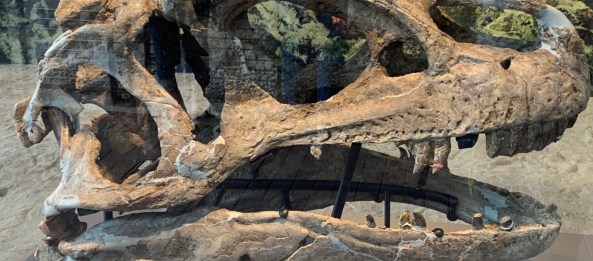
I had a chance to meet, talk and interview a park ranger who is a geologist and archeologist.  She told me that today the quarry is home to over 1,500 dinosaur bones and they encourage you in some places to touch the 149-million-year-old dinosaur fossils in the exhibit quarry.  It was exciting to hear her stories about the history of the park and the quarry.  The quarry contained eleven different species of dinosaurs such as allosaurusdiplodocus, and stegosaurus.  Check out the online multi- media exhibit of the quarry. When you see the quarry you wonder did paleontologists really discover the bones as they are presented, or did someone artfully place them here for effect?   Is this real or just a replica of what was in the past when they first dug up these bones? The answer is that paleontologists discovered the bones just where you see them today!  It’s incredible that everything in the quarry is real. The bones are just as nature arranged them more than 150 million years ago, deposited by an ancient stream.

The river coursed through a lowland area and dried up. Dinosaurs gathered around shrinking pools of water in the river bed and eventually died in place, to be entombed by sand and gravel when the river flowed once again. With more time, the river amassed large quantities of bones (like a huge graveyard, behind a dam). Layers of mud and sand began covering the bones, eventually hardening into rock. Here they remained, waiting for the next cataclysmic event and the explorers who eventually discovered them.
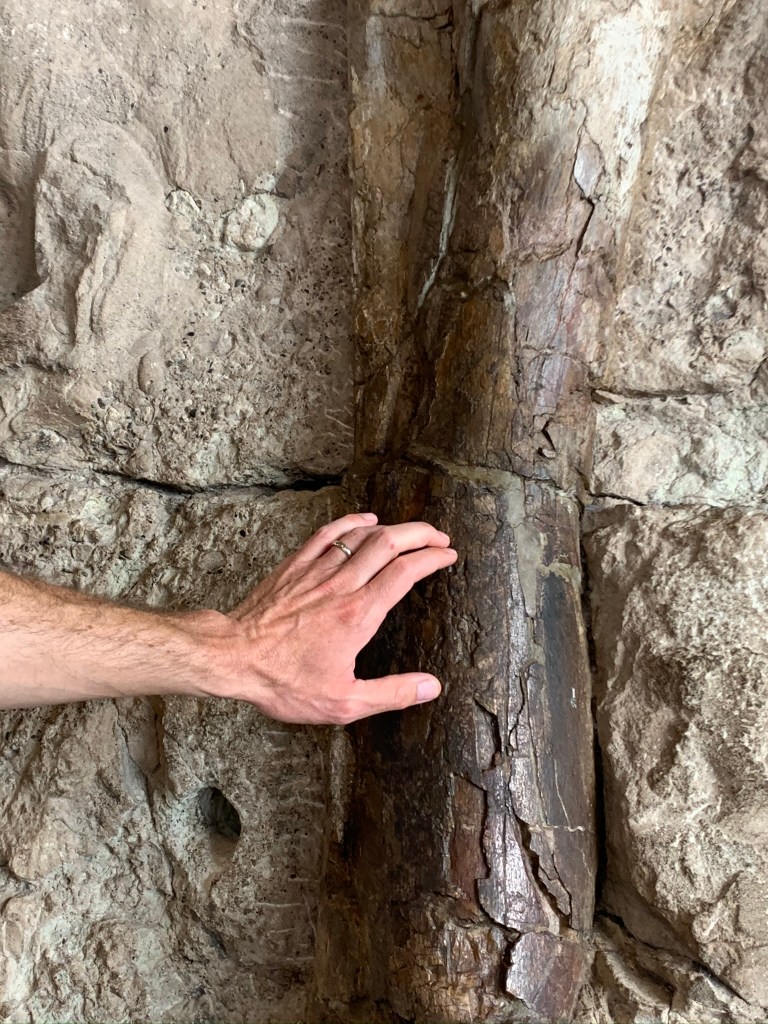
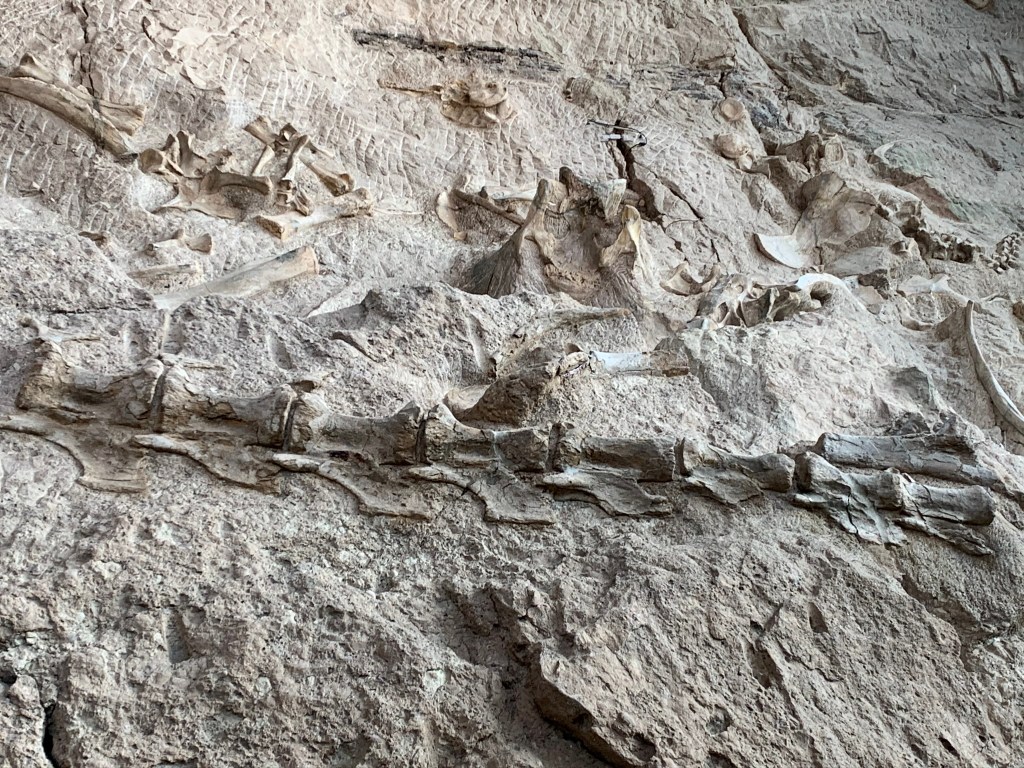
About sixty-five million years ago, that event began to occur. Forces beneath the earth’s crust began to exert themselves, forcing the crust upward, causing it to buckle and the riverbed containing the bones to tilt upward. Now near the surface, it was inevitable that erosion would eventually expose the bones and that one day someone would find them.  In 1909, Earl Douglas found the first bones of dinosaurs here as he was searching for fossils for the Carnegie Museum when he discovered a formation layered with prehistoric plant and animal fossils. A quarry was established and in 1915 Dinosaur National Monument was created to protect 80 acres in the quarry area as people were pilfering dinosaur bones. Today, the monument includes over 210,000 acres across two states. After this amazing experience, we returned to the visitor center via the discovery trail and by 10am it was already 90 degrees! 

We returned to our campsite only to be overrun with aggressive ground squirrels and chipmunks.  This is what happens when bad humans habitually feed the wildlife.  Bad humans!  So we headed to the River Access about a mile past the campground, to escape the little marauders.  It was relaxing to enjoy the Green River and admire the rock formations.  Let me tell you a little science behind all these different looking rock formations you will see in my video and below.
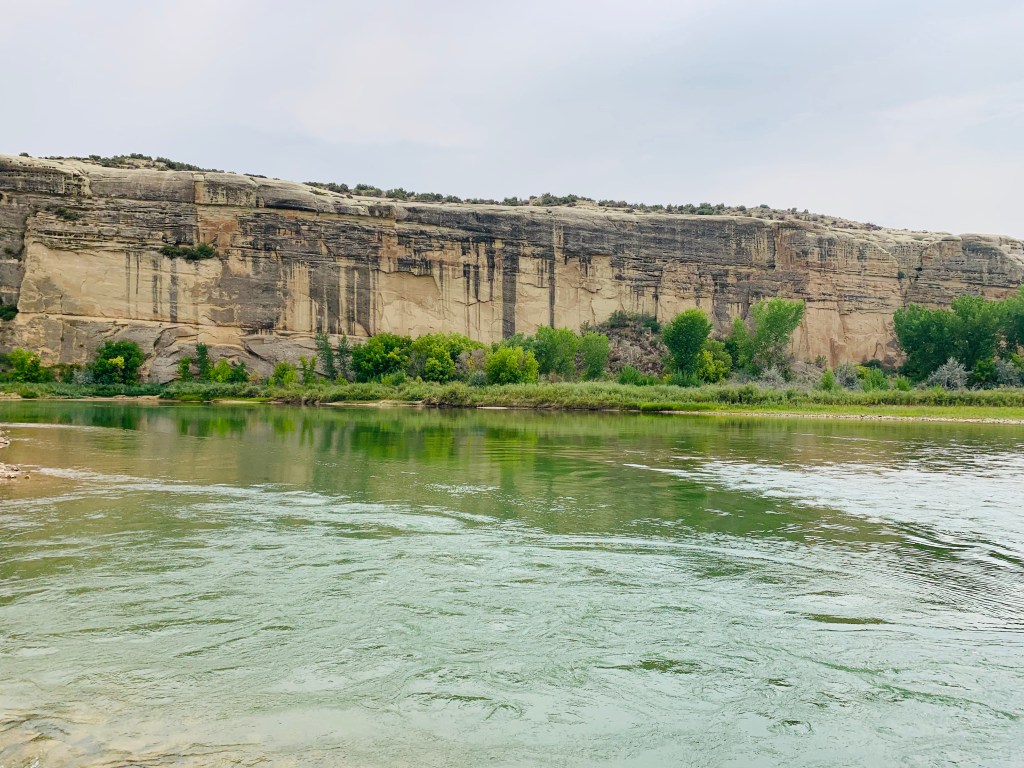
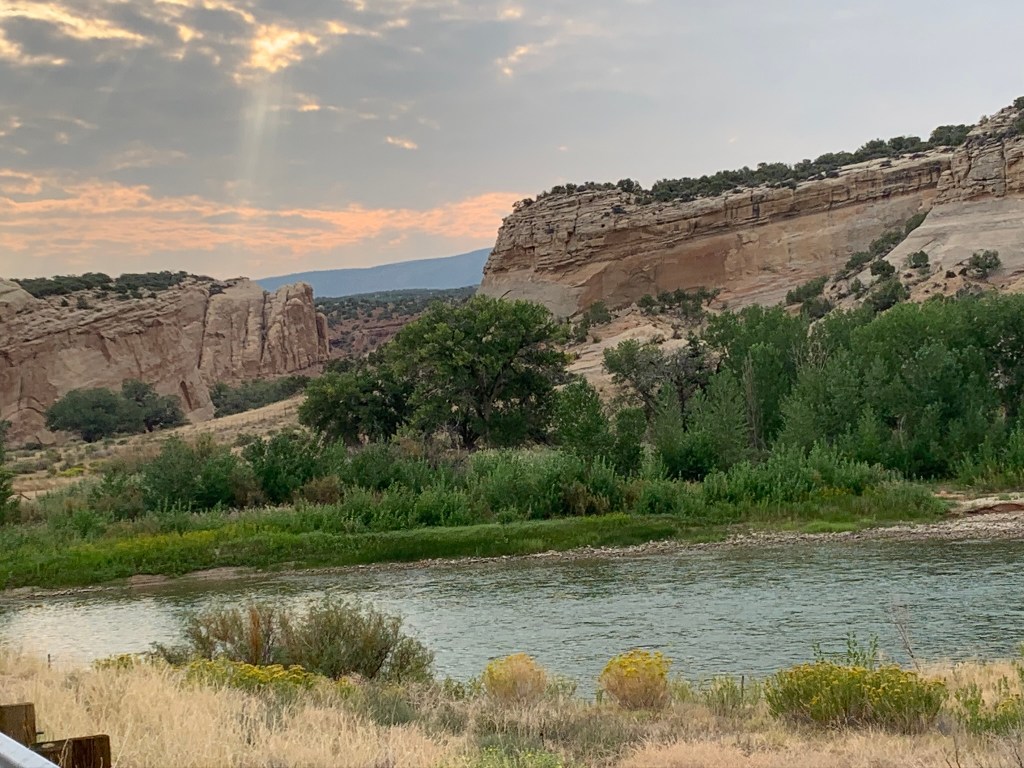
The geology and rock formations are amazing.  The following information comes from the National park Service.  Dinosaur National Monument receives less than 12 inches of precipitation a year, vegetation is thin and the rock layers and the geologic features are clearly visible.  Dinosaur is located on the southeast flank of the Uinta Mountains, a subrange of the Rocky Mountains and the highest mountain range in the contiguous United States that runs east to west. The landscape at Dinosaur was shaped by the development of these mountain ranges during the Laramide Orogeny, 70-40 million years ago.  Twenty-three rock layers are exposed at the monument. These rock layers are remnants of extinct ecosystems spanning 1.2 billion years, from ancient seas, to plains where dinosaurs roamed, to Sahara-like deserts that were home to tiny, early mammals. When the Rocky Mountains began to rise, this area went along for the ride.

At Dinosaur, the mountain-building did not simply push up the rock layers from below, but also squeezed them from the sides, warping and lifting them, sometimes cracking and shifting them along fault lines.

Throughout the monument, much of the spectacular scenery–the faults, folded and uplifted rock layers, and river canyons more than a thousand feet deep–reflect the tremendous geological forces that shaped this area.  You can see this at Split Mountain, the Sound of Silence hike (there is a virtual tour on my video of this hike) and the amazing canyon views on the Harpers Canyon Road in the Canyon entrance by Dinosaur, CO.  The Green and Yampa rivers are central to the extensive geologic history on display at the monument. Over millions of years, the waters of the Green and Yampa have cut deep canyons, exposing rock layers that were uplifted during the Laramide Orogeny.

The next morning before we left the monument, we road our e-bikes to visit two more petroglyph sites past the Green River Campground, hike Box Canyon and visit Josie Morris’s cabin (she was one of the first woman homesteaders in the area-you have to read about her amazing story).  Most petroglyphs in the monument came from the Fremont Indians, who lived in the canyons in and around Dinosaur National Monument 800 – 1,200 years ago. They were the forerunners of tribes such as the Ute and Shoshone, who still inhabit communities in the area today. 

Homesteading was a man’s world back in the 1900’s.  It was interesting to read about Josie defying the woman’s role as people knew it back then and paving the way for woman to own property. With no money to buy property, in 1913 Josie decided to homestead in Cub Creek in what is now the Dinosaur National Monument. Here she built her own cabin and lived for over 50 years in it mostly by herself. For a time, Josie shared her home with her son Crawford and his wife; grandchildren spent summers working and playing alongside Josie.
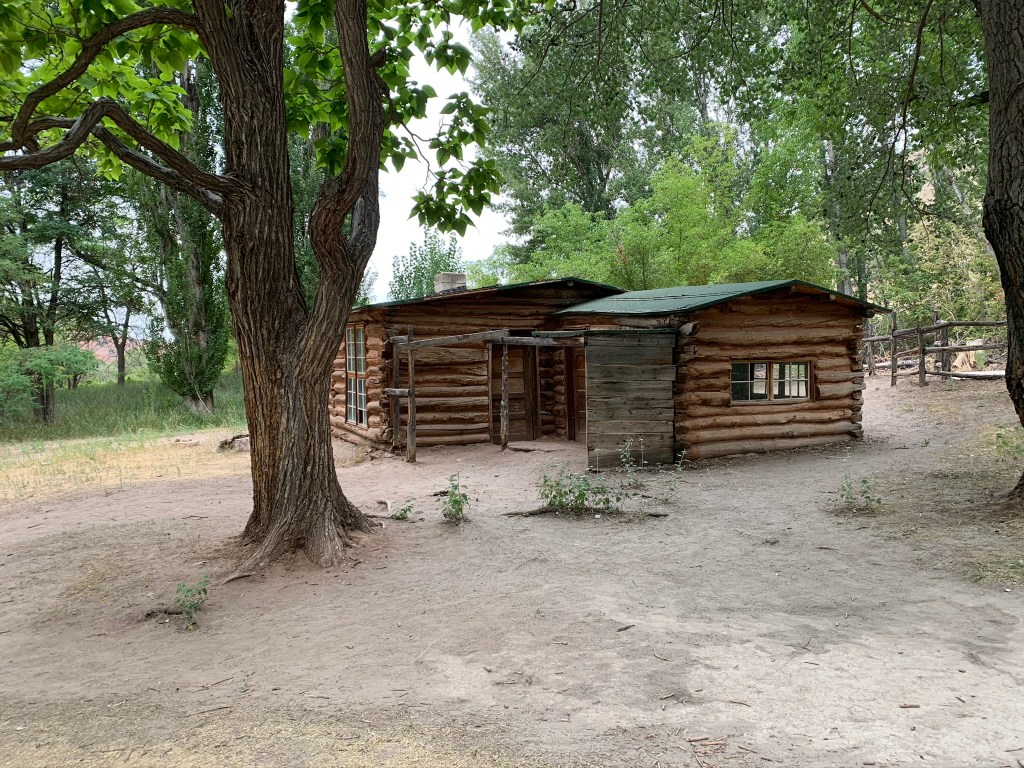
Raised on the frontier, Josie lived into the modern era of electronics. For friends and acquaintances in the 1950s, Josie was a link to a world past. During Prohibition in the 1920s and into the 1930s, Josie brewed apricot brandy and chokecherry wine. After a lifetime of dressing in skirts, she switched to wearing pants in her later years. She was tried and acquitted twice for cattle rustling when she was in her 60s. At the age of 71, in an ambitious move to revive a profitable cattle business, she deeded her land away and lost all but the five acres where her cabin still stands.

After our bike ride and hikes we headed out of the park and down highway 40 to the Dinosaur, CO Canyon Visitor Center entrance to see the canyon, change of vegetation and scenery.  It’s about 10 degrees cooler here because of the higher elevation.   We ended our visit by driving down Harpers Corner Road to see the Red Rock Canyon and Round Top Mountain and Island Park Overlook we were able to look down to the area we camped and explored which was an interesting perspective.  I recommend people of all ages to venture to this monument.  If you can’t make it, then you can watch our virtual tour.

Here are our top 5 things to do in the park:

  1. Do the tour of the quarry and if able the discovery fossil hike
  2. Hike the Sound of Silence during sunrise
  3. Camp at Green River Campground
  4. Check out the three Petroglyphs sites/hikes
  5. Cool off in the Green River at the River Access about 1 mile past the campground
Back to Changing the World or Not?

The old saying, “If I knew then what I know now”, echoes in my mind.

I would have not gone to the Hackathon in LA back in 2013 and when my doctor said I must rest. I would have had my husband hide my cellphone, laptop and taken it easy.  Instead, for the next six months, I still went online on my phone doing emails and answering what I thought were crucial emails and calling colleagues on how to execute important projects.

Of-course looking back none of it was more crucial than my health, I wasn’t saving lives, things could have waited.  Others within Microsoft would’ve taken the slack.  However, my ego was hard to reign in.  I thought what I was doing was so critical and no one else had the expertise and needed my coaching for things to be completed exactly the way I thopught they needed to be done.

Many of us think we can just ‘tough it out’ and work through cold, illness, etc.  What ‘toughing it out’ did do was postpone my recovery. Failure to heed my body’s warning signs caused dizziness, migraines, memory loss, executive function and slowed my multi-tasking abilities.  I now had to do eye therapy and my ability to focus  (switching from looking close and away) diminished to the ability of an eight-year-old and required me to relearn my focus and get glasses for the first time in my life.

So, after six months of eye therapy, no driving (Five years later, I still lack the confidence to drive and am only slowly adding in daytime driving for short distances.  But last month I did do my first long 200 mile drive from Bend to Newport, Oregon ), no television, no computer, no reading, no alcohol, no caffeine, no high intensity exercise, constant migraine headaches, dizziness, nausea, word searching, memory loss, six more black out concussions and lack of balance.  Then one day I awoke with a clearing in my head I had not felt in 6 months.  I went to the neurologist, she did some tests and said I think you are okay to go back to work but you must take it slow!  Do not jump fully in and do not take too much on you have been resting your brain for 6 months you need a slow transition back to work.

I did not realize her definition of slow was very different from mine.  Compared to the way I used to work, 12-18 hour days, I was only working 10 now.  Instead of traveling 3 weeks a month, I started with just a few days a month.  But as the months drove on, I was feeling more and more like myself again.

There was so much work to be done in diversity in computer science, combating human trafficking, committees for the White House Office of Technology Policy on computer science education for underrepresented groups and technology implications of human trafficking, hackathons, hacks for good, conferences, keynotes, panels, guest lectures, publications, projects with UN Women, NCWIT, ABI, CRA-W, ACM-W and the making of Dream Big (movie featuring young women in computer science changing the world), that I started back to my 16 hour days, and my crazy travel of three weeks a month.

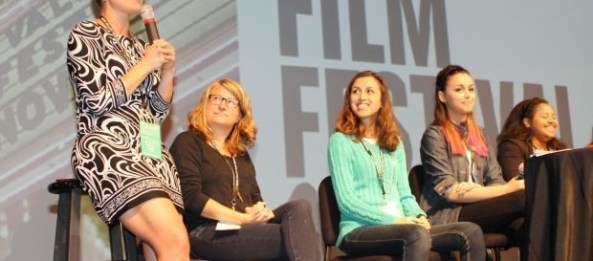
Rane moderating Big Dream Panel at the Napa Valley Film Festival

Taking on diversity and Computer Science efforts at top universities around the country heading to India, Korea, UK, Brazil, Singapore, and across the United States.  In a previous blog post, you saw our film was featured at the Napa Valley Film Festival and was being shown all over the world.  I was so excited about the progress!  Also, the fact that Microsoft and Microsoft Research’s efforts were highlighted in many of the top publications (i.e. Slate, NPR, Huffington Post), I couldn’t but help agreeing to serve on nonprofit boards needing our help and expertise, at one point I was on thirteen boards.  My hubris and type A drive which had carried me so far was a hindrance to my healing.

At every free moment, I was working on some project with one of the many non-profits (as you know I am a get shit done person and not just a sit and advise type person).  In my spare time, I was at home trying to transform my local community (Bend, Oregon) by supporting more STEM efforts, starting a scholarship for under-represented groups in computer science and engineering at OSU-Cascades, helping entrepreneurs, volunteering with the tech community and local youth, mentoring and teaching a course called ‘Ethics and Computer Science’ at OSU-Cascades. I could feel the exhaustion coming on but I thought to myself “just one more conference and then I will take two weeks off and be fine.”

I am here to tell you, we are not robots and you can continue to ignore the signs your body gives off but if you don’t listen it will force you to listen.  As Type A workaholics, passionate and ready to take on the world are bodies are resilient but not that resilient!  You cannot ‘tough it out’ you must pause when your body needs a pause even if it is just a mental health day from work.

So, on May 23, 2015, while attending a conference on behalf of Microsoft I had just finished several sessions and presentations at Day one of the NCWIT Conference in Hilton Head.  I had a dinner meeting with Mayim Bialik (Big Bang Theory-that was so cool!) discussing our film and her possible support and how Microsoft could possibly support a new Girls in STEM TV series she was going to kick off.  We returned to the hotel and I saw several of the researchers I was working with on a number of projects at the bar talking asking me to come join them.

After discussing theories, projects, new opportunities and changing the world of computer science it was reaching midnight and time for me to head for bed.  I was tired and started to feel a pain in my side (later I would figure out that would be a sign that I would blackout soon) but I ignored it and kept on.  As I walked away from the bar area to the elevators, the next minute I know I awoke in someone’s arms, with so many people surrounding me, all dazed and confused as I try to get up.  There was shouting, “Rane don’t move you’re bleeding and bleeding a  lot.”

Suddenly, EMTs are walking briskly toward me as my eye sight slowly comes back from a fog of gray and blurs.  “Ma’am you blacked out and hit your head, you have a good side gash on your head, can you just lay back we are going to put you in a neck brace and start an IV?” said the nice EMT gentleman.  One of my research friends from Harvey Mudd University began telling the EMT what had happened and he had her and a staffer from NCWIT follow the ambulance to the Emergency Room (thanks Catherine & Colleen).

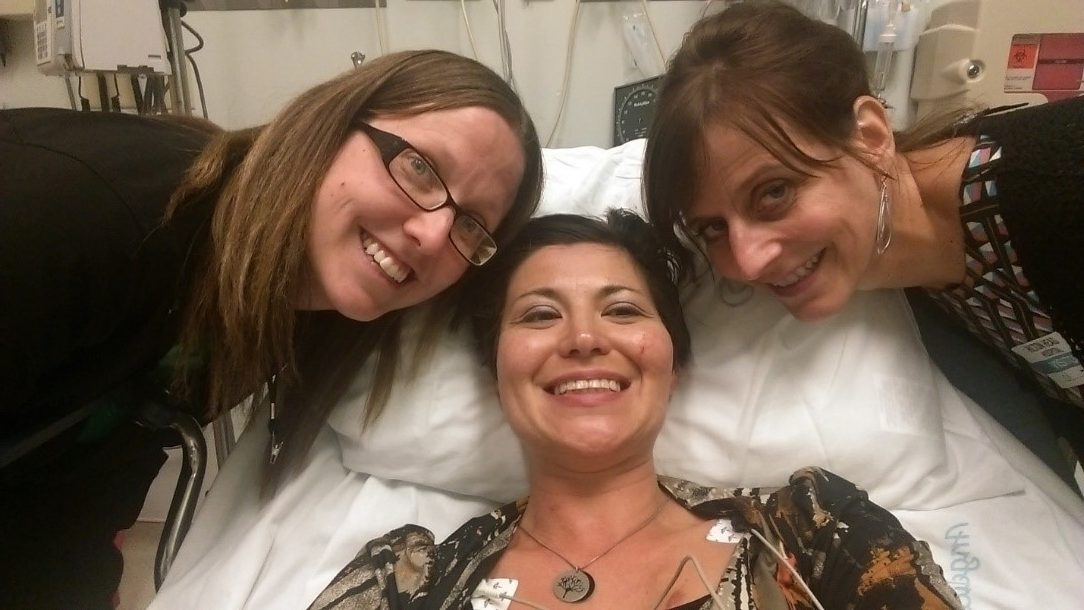
Rane in emergency room sending selfie to her husband to calm him down, trying to make it look not so bad.

I had thrown up a few times in the ambulance (sorry Mr. EMT guy- all over him) and still could not comprehend what was going on. While waiting for the doctor, my colleagues called my husband and tried not to scare him with me being in the emergency room again and blacking out after hitting my head.  Once they were done, then I was taken for MRI, CT Scan, stitches and forced to stay awake for a few hours to ensure I wasn’t going to go to sleep and never wake up again.  I finally got back to the hotel at 4AM looking like a semi-truck hit me, it took me an hour to wash all the coagulated blood out of my hair. I went to sleep and at 10am I awoke to call the airline and get a flight back to Bend, Oregon to go to my neurologist.  I flew out with frustration, here we go again.  With a horrible migraine, nausea and dizziness, I headed to the airport to what would be a multi leg eight-hour (the take offs and landings were excruciating with another concussion) flight before I finally got back to Bend and into the arms of my husband. It was also so humiliating for an extremely independent person to be whisked on and off the planes on a wheel chair as people looked at me like oh that poor young woman. Talk about a humbling experience.  I was beaten down.

This resulted in the next several years of trying to figure out why I was blacking out, thirteen more concussions resulting in me having traumatic brain injury and fighting the insurance company for my long-term disability.  Who would know the benefit you pay into hoping you will never have to use would be so difficult to obtain.  Once you need this benefit, how difficult it is to get it, even harder to keep it and then battling their doctors, lawyers, appeals and lawsuits to get the money and benefits you need, deserve and have earned. No one explains how you need to fill out all these forms and one little error can make your benefits never happen.  Having to go on unpaid medical leave due to this (I will have an entire blog dedicated to this subject later in my blog series to help those dealing with long-term and short-term disability claims, so you know what to do to get the benefits you deserve).  I would move from one doctor visit a year with my primary care for annual physical and flu shot to multiple visits a week with the following healthcare providers: Neurologist, Vasovagal Specialist, Optometrist, Vestibular Therapist, Occupational Therapist, Neurofeedback Psychologist, Psychologist, Acupuncturist and Chiropractor.

I didn’t realize how life threatening it could be for you if you tried to just push through the pain.  I plead with you if you have a concussion to please take the needed time off and screen time off! I learned the hard way and trust me you don’t want to go through this.  During this process, I had to get character letters from friends and colleagues about the Rane before and the Rane after all these concussions for the lawyers and it was painful to read the new person I had become.  As I researched what was wrong with me, I realized we still don’t know much about the brain and especially concussions. I read and listened to everything I could on TBI and concussions.   I will spare you with the peer review scholarly research publications (they are quite dry, interesting but will put you to sleep) but here are my top three books for you to read if you or a family member is dealing with this issue.  Next week, my blog will be on lessons learned on how  Type A’s can rest your brain.

  1. Super Better by Jane McGonigal
  2. Mindstorms: The Complete Guide for Families Living with Traumatic Brain Injury by John W Cassidy
  3. Coping with Concussion and Mild Traumatic Brain Injury: A Guide to Living with the Challenges Associated with Post Concussion Syndrome and Brain Trauma by Barbara Albers Hill and Diane Roberts Stoler

Celebrating International Women’s Day

Raneheadshot2014 Despite all the efforts, wide gender imbalance still exists in innovation worldwide, with number of women in science, technology, engineering and math (STEM) fields decreasing from secondary school to university, laboratories to teaching, and policy making to decision making.

At the same time, most developed countries are forecasting an alarming shortfall in the number of skilled people to fill these jobs. The International Telecommunications Union predicts that 90 percent of future professional positions will require information and communications technology skills as well as a solid background in science or technology. Developing women’s competencies will widen the pool available to perform these tasks, while opening opportunities for women to pursue their dreams.

iwdThis is why Microsoft believes in the importance of diversity to drive innovation and the need to enable women all over the world to become producers of tomorrow’s technology. I am excited to join Microsoft executives Lori Forte Harnick and Margo Day, as we partner with U.S. Chamber of Commerce Foundation’s Corporate Citizenship Center, United Nations Office for Partnerships and UN Women, for the 5th Annual International Women’s Day Forum: The Empowerment Bridge: Building Economic Empowerment for Women and Girls, held in New York City Wednesday and Thursday.

This event is particularly important to me, being a first-generation Vietnamese American. I was an immigrant at-risk youth who was emancipated at age 14. It was an interest in science, engineering and technology that helped me grow out of poverty and become a leader in the field. To see young women around the world embrace this field and create solutions that will make a difference inspires me every day and excites me to represent Microsoft as we partner with amazing organizations to enable every girl in the world reach their full potential.

I am excited to work with Lori, who leads Microsoft’s global work on corporate social responsibility as general manager for Citizenship & Public Affairs. She will kick off the event with Marc DeCourcey, vice president of the U.S. Chamber of Commerce Foundation, Corporate Citizenship Center. Personally and professionally Marc has seen how lives and entire communities are transformed when women are empowered. Through his work with the Red Cross and currently with the U.S. Chamber of Commerce Foundation, he understand the value of business, nonprofits and governments all coming together to improve lives.

Lori’s passion to help students all over the world makes her perfect for this event. Not only does she lead Microsoft’s social responsibility and service, legal and public policy arm, she serves on a number of boards and an advocate in the community. I love that she is an active volunteer for Global Give Back Circle, which integrates mentoring, private sector engagement, government and local community support to help at-risk girls in Africa complete their education, gain employable skills and transition into the workplace.

Lori will be speaking about sustainable development goals and the role of the business community during a panel Thursday. She has been mentoring Egypt-born Raneem Medhat as part of Microsoft’s YouthSpark initiative. “She is a few months away from graduating university with a computer science degree,” Lori says of Raneem. “It is really interesting to work with her at this juncture in her life.”

Also, as part of the event, Microsoft’s Vice President of U.S. Public Sector Education Margo Day will have a discussion about accelerating STEM education with Anna Maria Chávez, chief executive officer of Girl Scouts USA and Tina Tchen, Michelle Obama’s chief of staff. It will be an inspiring and action-filled session, with one of my favorite broadcast journalist Soledad O’Brien of CNN moderating.

Margo is perfect for this discussion not only because she is leading our work in education across the country, but in September 2011, she stepped away from her role at Small and Midmarket Solutions and Partners to focus her passion and energy on raising funds and awareness for the Kenya Vulnerable Girls Education Project and Child Protection, partnering with World Vision, an effort that built schools and deepened community advocacy for education.

We will end the day with a screening of “Big Dream” and a panel discussion with the director, and a student from the film, as well as partners UN Women and Global Girls Collaborative Project.

Underwritten by Microsoft, “Big Dream” follows the intimate stories of seven young women who are breaking barriers and overcoming personal challenges to follow their passions in science, math, computing and engineering. Much like International Women’s Day itself, the hope of the film is to show young women all over the world that computer science is creative, collaborative and impactful ― and they can be producers of the solutions that will solve the world’s greatest challenges.

Learn more on how you can enable women around the world:

Host a free screening: Big Dream Movement
Learn: Free CS online learning for girls
Find resources: UN Women Empower Women
Find STEM organizations near you: National Girls Collaborative Project, US Chamber Commerce Foundation
Watch the State Department’s American Film Showcase