On the Road to Eastern Oregon

We are back on the road, yeah!  As Oregon and much of the USA is starting to re-open and even in some places in phase 3 of 4 phases of re-opening, it seemed we would be okay to head back out. Plus, Newport allowed vacation rentals to begin hosting guests again, so our beach house has been rented and we need to move on before guests arrived.  Before hitting the road, we called several BLM, Forest Service and state park offices and they all said YES, WE ARE OPEN, so we headed back out on June 8th.  We decided it was time to explore Eastern Oregon, being Oregonians most of our lives it is a shame we haven’t explored it more, so here we go. We like to limit our daily driving to less than 125 miles, so we took our time heading toward Eastern Oregon.

As we left the coast, we stopped first at a nice boondocking spot on Highway 20 after Sweet Home by the Willamette National Forest sign, past Cascadia Campground but there was zero cell coverage and we needed to make sure our guests got in okay.  After dinner we headed back up Highway 20 east past Tombstone Pass where there is a nice snow park (Lava Lake) with cell reception that we boondocked for the night.  The next morning after breakfast we headed to Bend where we took a friend’s advice to boondock on BLM lands near Pine Mountain Observatory.  It is very secluded, pretty much just sage brush, cows and miles of pretty rough dirt roads (we call is moon dust because it is fine and just gets into everything).  If you like seclusion you will like this area, we got a little tired after driving 10 miles on rough dirt roads before we could find a good pull off stop.  We’d suggest boondocking at the big flat parking lot by the Badlands instead, as its super easy and not far off Highway 20.  We saw several RVs stopped there and the Badlands is a great place to hike with your four-legged friend.

The next day, we stopped at Chickahominy Reservoir which is a great BLM camp spot for only $8 a night/ $4 for Golden and Access Pass holders.  There are several waterfront sites (28 total sites), they are spacious and dispersed a good distance between each other that you feel you almost have the lake to yourself.  It is stocked twice a year with rainbow trout and there were several anglers fishing the banks and in boats.  The location has a fish cleaning station, picnic tables, fire-rings, drinking water, trash cans, vault restrooms and a boat ramp.  We enjoyed this spot for a couple of days and did bike rides and runs around the reservoir.

We then ventured to Chukar Park near Juntura, Oregon another BLM camp spot which was only $5 a night/ $2.50 Golden and Access Pass holders.  It was more primitive, with just picnic tables, fire rings, vault toilets and the water wasn’t turned on yet when we were there.  It is set next to the Malheur River but its very overgrown so you can’t see the River, there are nice full sun and shade sites depending on your interests.

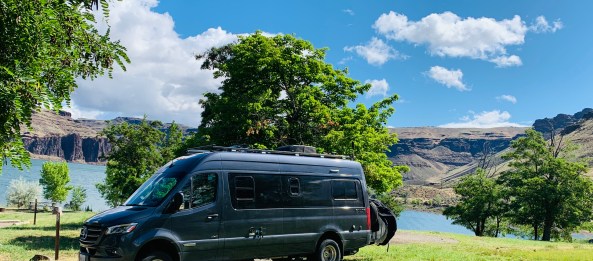
Next, we boondocked about ¾ mile past Snively Hot Springs in the Owyhee Wilderness on Snively Gulch Road.  It is a fairly even and flat gravel area along the Owyhee River that leads to the Owyhee Reservoir.  We stayed there a couple of days and only ventured to the Hot Springs once, as it rained so much that the water was really muddy and not to appealing.  The hot springs felt great and there are two pools one quite hot and the other more luke warm.  We decided to head up to the state park and check out the main campground by the dam.  There are many boondocking spots along the river all the way to the dam, the road gets very narrow and up against steep cliffs with a lot of rock falls (we saw a rock fall on the vehicle ahead of us).  It gets a bit stressful as there are a lot of large trucks hauling boats and 5th wheels and barely enough room to pass each other in many spots.  The state park campground is nice with 67 campsites at McCormick Campground and then Indian Creek Campground around the bend both  having full electrical hook ups and tent primitive sites, with showers, bathrooms, trash, fresh water, dump station, fire rings and picnic tables.

We had a lot of wind and rain for June so we decided to head to some sun and heat in Idaho and ventured to Morley Nelson Snake River Birds of Prey Conservation Area outside of Boise, Idaho.  Do not take the short route on Google Maps that goes directly to the boondocking spots it takes you to private property and you cannot take the road through.  You need to go through Kuna and down Swan Falls Road, a much better route.  Idaho Power actually maintains 18 campsites even with trash cans with picnic tables and fire rings, we saw an employee every morning going to and cleaning out camp spots. Please be a conscientious camper and don’t dispose of trash that does not burn or cans in firepits as there are dumpsters just up the road at the dam and boat ramp. After the 18 they maintain then it turns to BLM camp spots that are not very well maintained and are more primitive.  The road is a mixture of hard dirt and gravel, there are parts that are very rutted out.  I would recommend 4X4 Class B and C and smaller truck trailer RVs.  We were surprised to see a Class A size 5th wheel make it down the road and into one of the sites, I wouldn’t recommend it though unless you are very confident about your driving skill and rig.

You may stay here free for 14 days, it’s a beautiful spot on the Snake River and amazing wildlife to view. We saw so many birds of prey (falcons, hawks, eagles, osprey, pelican), coyotes, lizards, a rattlesnake or bull snake, jumping bass and deer, the wind is super strong here.  There are rattlesnakes so watch out!  We ran into a baby snake in our camp, ground squirrels and there are ground hog like looking animals everywhere.  It is also a popular place for locals to rock climb, fish and play in the river.  Watch out for some fast vehicles going down the dirt road if you are biking or running.  We hope you may enjoy visiting these spots.  Below are hyperlinks to the descriptions and GPS coordinates from freecampsites.net.  Next week, we will tell you about our stay in the McCall, Idaho area and our request from our subscribers to help us plan the rest of our Summer and Fall travels.

  1. Tombstone Snow park
  2. Badlands by Bend, OR
  3. Chickahominy Reservoir
  4. Chukar Park
  5. Snively Gulch Road
  6. McCormick Campground
  7. Snake River
  8. Check out our video of this trip!


Camping & Exploring the Painted Rock Petrogylphs

paintedrock

If you have been following us, you know we put our home in Bend for rent for a year and have moved in our 2020 Winnebago Boldt for the year and if we like it or not this is our home until March 26, 2021.  So it has been a little over a week and a half since everything began closing down all over the country due to COVID-19, while we already started our one year trip visiting all the National Parks. We headed out of Bend, OR on March 1st where everything was okay and the world was functioning like whatever was everyday normal as we knew it as Americans.

Since then, we were able to visit the Lava Beds National Monumnent, Eagle Lake, Washoe Lake, Travertine Hot Springs, Alabama Hills, Death Valley National Park, Mojave Desert National Monument and Joshua Tree National Park. (More videos and blogs to come regarding each spot.)  While in Joshua Tree, state parks and national parks across the country began to shut visitor centers and some campgrounds. Many have now waved their frees and you can visit but there are no services. We have decided to go to places where they are in BLM or National Forests where there is free dispersed camping and you are well away from other campers.  We have a Pacific Pride Cardlock to fill at commercial diesel gas stations, so no interacting with people.  The only place we have to interact is grocery store which we try to only visit once a week or less.  We are trying to utilize the Walmart Grocery free curbside pick up service, but seems like everyone is doing that too.  When in a grocery store I am using gloves, distancing myself 6 feet from other shoppers, using the self-check out and going at times where there are the least amount of people.

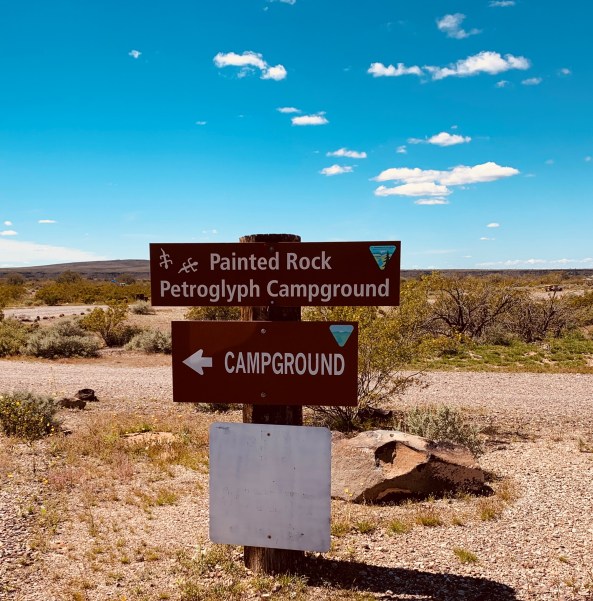
So far we are still able to camp.  We were at Truckhaven Palm Wash BLM area and met a super nice local who wanted to make sure we weren’t stuck without resources.  Don’t worry we social distanced ourselves- him being outside our rig and us inside talking through the window.  Mike offered us ideas on nearby places of interest, where to dump and fill our RV if we needed it.  After Truckhaven, we headed to the BLM Pilot Knob Long Term Visitor Area, where it is free camping for 14 days and you are at least 500-1,000 yards from another camper.  This is different than Imperial Sand Dunes where there are a lot of RVers that are very close to each other, we would not recommend that area.  Today we arrived at thePainted Rock Petroglyphs, which are super cool. There are very few people here and social distancing is keeping us about 500 yards from other RVers.

sunsetpaintedrock

The Painted Rock Petroglyph Site is located on the eastern edge of the Painted Rock Mountains and about eighteen miles west by northwest of Gila-Bend, AZ. (information pulled from Wikipedia and BLM websites) The area is mostly flat and sandy with May-Oct daytime temperatures in the 100s. While we were here it was in the mid 70s in end of March.  The annual rainfall is only about six inches and the nearest irrigation water is the Gila River. In prehistoric times the Gila flowed west out of the mountains of western New Mexico, made a big dogleg turn at the town of Gila Bend and continued west to empty into the Colorado River. The Hohokam people once lived and farmed here. Ruins of their late Pioneer Period (AD 350 – AD 550) and Early Colonial Period (AD 550 – AD 700) villages are found to the north and west, and ruins of their Sedentary – Classic Period (AD 900 – AD 1400) villages are found to the south and east.  Over forty petroglyph sites have been recorded in the area, however; most of these sites are small with only a few dozen petroglyphs. The Painted Rock Site is the largest known site with about 800 images. While on my exploration I had the entire place to myself and did not cross anyone else.  Tomorrow I am heading out with Greg and Bode to hike on the historic Butterfield Overland Stage Route this was the old Oxbow Route that had mail travel from St. Louis to San Francisco back in 1858.

I recorded a short video for you to do a virtual tour and create activities for your children while they are off from school.  ( I have had requests from friends to do these little virtual tours).  I hope you enjoy it.  Keep checking back to our blog as we keep you up to date on how our  travels are going during this time and what you can and can’t do if you are a full-time RVer in the USA right now.

Visiting the Redwoods National Park

IMG_2958

Hi from RGB (Rane, Greg, Bode) Adventures, we have decided to do our series a little out of order.  I did not realize that the Redwoods and the far Northern California Coast has so little cellular service.  This rugged and isolated stretch of coastline has been called ‘The Lost Coast’ for good reason.  The videos on how to choose your RV, Why the Winnebago Boldt, the ‘shake down’ tour, and getting our RV fixed under warranty will be delayed until we hit good cellular and wifi services.  We have jumped ahead to our first roadtrip the through the California Redwoods.

We left Junction City and Eugene, Oregon exhausted on a Friday evening so we weren’t creative and boondocked at the second rest area south of Eugene near exit 40 in Oakland, Oregon.  It isn’t bad and not too loud; a small herd of deer were walking through when we arrived.  The highlight for Bode was a full poop bag dispenser and dog walking areas.  Gotta keep all members of our tribe happy.

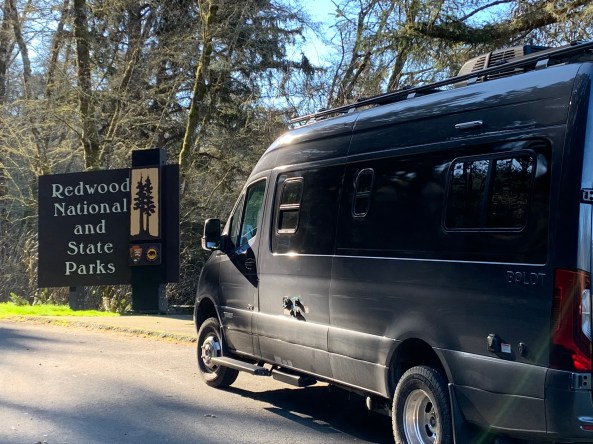
Oregon allows you 12 hours at their rest areas, so we got our 12 hours of shut eye and then headed south to the California Redwoods.  As you will see from the video and images on our Facebook page, it is a beautiful drive and not that many cars in the winter time. We started in the pouring rain of the Valley and the clouds parted and the beautiful sun beamed down on us the rest of the trip towards Crescent City.  Our first stop was off Highway 199 at the Eight Dollar Mountain Botanical Wayside Boardwalk and Jeffery Pine Loop.  We highly recommend it as a good place to move the legs before the final push towards Crescent City.

We would also suggest since there are so few people here in this isolated and seldom visited part of Oregon that one could stop at the Jeffery Pine Loop Trail head if you are tired, this could be a great boondock spot.  There are not overnight parking restriction signs, so we think you should be okay.  From here we headed back on the highway 199 to Crescent City and about 10 miles before you get to Crescent City you will hit the Smith River National Recreation Area.  We highly recommend Madrona River Access (near Gasquet, CA), it is the only free campground (max 7 day stay) where you can boondock at no charge.  We got a great spot next to the river and there is even a firepit and picnic table for you to enjoy.

Next, we stocked up at Crescent City and stopped by the visitor office for the Redwood National Park, there we got our map and the lowdown on what to see.  The Redwood National Park is paired with the California State Park system so you will need to pay state park fees if you stay at any state parks overnight.  We checked out the following trails and viewpoints in the National Park: Vista Point, Coastal Trail at Crescent Beach, Damnation Trail, Overlook, Yurok Loop Trail, and Klamath River Overlook.

photocollageredwood

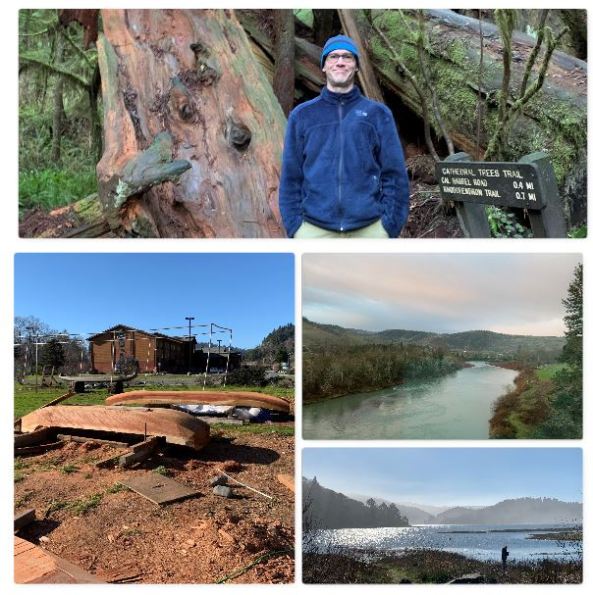
You will find driving an RV takes a lot more work than your SUV or passenger car and you get tired quick (I know this as the navigator taking care of the grumpy driver who makes specific point on how easy I got it as cook and dog mom.  I will admit out of 4,000 miles on the odometer I’ve driven about 40 J.) so instead of heading all the way down to the next campground we decided to just boondock.  The Yurok Redwood Casino are happy to allow you to stay for free in their lot, you just need to go inside and register your vehicle.  It was quiet and we had the wonderful opportunity to get a tour with the handmade dugout canoes being made out of large Redwood logs.  According to the craftsman that we spoke to he learned the trade from Yurok Tribal Elders and was trying to pass on the tradition to the Yurok children.  He was worried that the next generation wasn’t too interested in learning this important tradition but the tribe had put together a program for him to have interns and children to train.  The forest service allows the tribe to take a 6-8-foot Redwood Trunk that takes them 3 months to dig out.  He showed me the traditional tools and rocks they used back in the days but now he uses a chain saw, sander and modern tools so instead of 2 years it takes 3 months.  He explained the important carved out parts inside the canoe being the nose, heart, and kidneys of the boat.  The tribesman has 3 months to make 8 canoes and he was working on his 3rd.   If you are interested the Yurok Tribe is planning to offer traditional dugout canoe tours on the Klamath River beginning Spring 2020.  It was interesting to learn a bit about the history of the largest tribe and (according to the tribe member) unfortunately the poorest tribe in California!  It was sad to see when I did a little more research that after the Gold Rush 75% of the tribe was decimated from massacre and disease from settlers.

The next day we checked out the rest of the National Park.  I forgot to tell you the National Park is free, so you don’t need your annual pass but they charge for all the campgrounds and there is no discount.  One thing I did learn though is if you have a disability like me (which is another long story, check out my TBI blog), you can get a lifetime National Park Pass called the Access Pass for free with your Social Security SSA Benefit Letter!  We got the access pass, too bad we already paid for annual pass but now we have a pass for lifetime!  So cool and a nice benefit for those with disabilities!

After the Yurok Casino make sure you take exit 765 and take the lovely Newton B. Drury Scenic Parkway through the park instead of the 101 or you will miss most of the big Redwoods.  That’s what you’re here for after all right, so slow down and enjoy the windy slow ride.  For the rest of the park we scoped out the Coastal Trail to Flint Ridge, Ah-Pah trail, Big Tree Wayside (my favorite), Elk Prairie, Elk Meadow, Stone Lagoon (Be careful if you are in an RV it is steep one lane road in sand- we wouldn’t recommend it in a camper van or bigger), Big Lagoon and Patrick Point.  We were here in winter, during February, so the road to Gold Bluffs Beach was a little treacherous and suggested by the forest service to not go down in our Sprinter. The camp grounds at Elk Prairie and Patrick’s Point were very underwhelming at $35 a night as many of the campsites are closed in the winter and only have a water spigot, picnic table, fire ring, bathrooms and showers are closed for the winter (no hookups or RV dump stations).  So we headed on down to Arcata to talk to the BLM office and figure out our next spot, tune in to next week as we describe Humboldt Redwoods State Park, the Avenue of the Giants and wine tasting in Napa! In the mean time see the video on our adventures or learn more about the Redwoods and Yurok tribe.

Action:

1. Check out our video on our adventure & subscribe to our channel

2. Learn about Redwood National Park

3. Learn about the Yurok Tribe and taking Canoe Tours this Summer