As many of you know—especially if you’ve been reading my blog posts—the participation of women in computer science continues to decline. Last year, women accounted for only 14 percent of computer science college graduates in the United States, according to the Computing Research Association. That’s down from 37 percent in 1985, despite US Department of Labor statistics that show computing to be among the fastest-growing career fields, with a shortage of qualified candidates to fill available openings. In addition, studies reveal that executives value the variety of perspectives that comes with team diversity, yet another reason for needing greater female participation in computing fields.

As a technology company and innovation leader, Microsoft is passionate about increasing the participation of women in computing. To do so, we must attract more female students to science, technology, engineering, and math (STEM) programs. To maintain their interest in STEM programs, we can increase young women’s exposure to the myriad opportunities in computer science and provide them with support during their undergraduate and graduate STEM studies. This is why Microsoft Research is proud to support the NCWIT Academic Alliance Seed Fund and to fund the Microsoft Research Graduate Women’s Scholarship.
The National Center for Women & Information Technology (NCWIT) is a non-profit community of more than 500 universities, companies, non-profits, and government organizations nationwide working to increase women’s participation in computing and technology. NCWIT helps organizations more effectively recruit, retain, and advance girls and women in K-12 through college education, and from academic to corporate and startup careers. The NCWIT Academic Alliance brings together nearly 750 distinguished representatives from academic computing programs at more than 275 colleges and universities across the country—spanning research universities, community colleges, women’s colleges, and minority-serving institutions. In 2007, Microsoft Research initiated the Seed Fund in partnership with NCWIT Academic Alliance. The NCWIT Academic Alliance Seed Fund provides US academic institutions with grants (up to US$10,000 per project) to develop and implement initiatives for recruiting and retaining women in computer science and information technology fields of study. Through 2013, the Seed Fund had awarded US$465,450.
In partnership with NCWIT Academic Alliance, we are pleased to announce the 2014 winners:
- College of St. Scholastica (Jennifer Rosato) Promoting Female and Diverse Student Retention through Faculty Use of a Growth Mindset Approach This project will provide professional development for faculty at The College of St. Scholastica, helping them to instil a growth mindset among women and minority students who are majoring in computer science and associated concentrations, as well as fostering the continued interest of students taking pre-engineering courses.
- Georgia Gwinnett College (Sonal Dekhane, Kristine Nagel, and Nannette Napier) Georgia Gwinnett College Women in IT Boot Camp A weeklong workshop, the boot camp will give 24 promising female IT sophomores an opportunity to get a head start in programming.
- South Carolina Technical College System (Stephanie Frazier and Salandra Bowman) SCTCS Triple A Academy The academy will immerse 10 to 14 female students—each of whom is enrolled in a certificate, diploma, or degree IT program—in a one-week program that promotes ability, acuity, and audacity (the triple As) in IT-related fields.
- Tufts University (Benjamin Shapiro) Engaging Women in Computing through Musical Instrument and Performance This unique project will design a curriculum and an accompanying set of hardware and software tools that teach computational thinking and engineering through the design and construction of tangible, programmable electronic musical instruments that youth can use for live performances.
- University of Arizona (Gondy Leroy and Paulo Goes) Tomorrow’s Leaders Equipped for Diversity The university’s department of management information systems (MIS) will team with industry to make computer science and MIS students aware of diversity issues, with a special focus on gender, preparing the students to be leaders and managers who are equipped to both counter the problems and leverage the benefits of diversity.
In addition, we know that a woman’s first two years of computer science graduate study are the most critical. During this time, she must determine her area of focus, increase her confidence in the field, enhance her capabilities in publishing and research, and build her network. This is why Microsoft Research created the Graduate Women’s Scholarship, which provides a US$15,000 stipend, plus a US$2,000 travel and conference allowance, to women in their second year of graduate study at a US or Canadian university. The scholarship helps recipients gain visibility in their departments, acquire mentorship, and cover the burgeoning cost of graduate programs.
We are pleased to announce the winners of the 2014 Microsoft Research Graduate Women’s Scholarship:
- Anne Holladay, Carnegie Mellon University
- Claire Chow, University of Notre Dame
- Yunmeng Ban, University of Massachusetts Amherst
- Sruthi Polali, Rice University
- Nan-Chen Chen, University of Washington
- Ghazal Fazelnia, Columbia University
- Tesca Fitzgerald, Georgia Institute of Technology
- Angelica Ruszkowski, University of British Columbia
- Brooke Fugate, University of Pennsylvania
- Elizabeth Mamantov, University of Michigan
Congratulations to all the winning programs and students. We look forward to great things from 2014’s women in computing.
—Rane Johnson-Stempson, Principal Research Director, Education and Scholarly Communication, Microsoft Research Connections Learn more
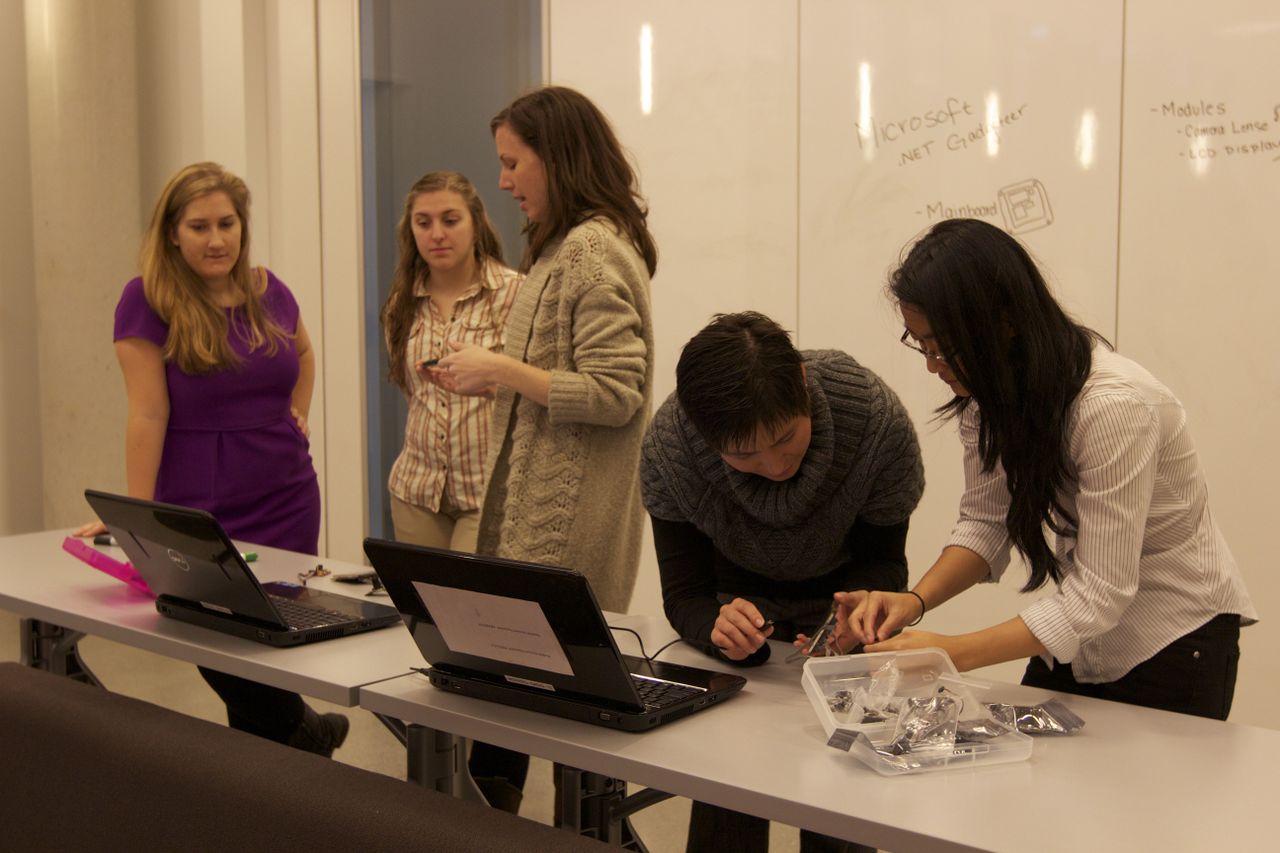

 The hackathon provides an opportunity for female students to demonstrate their technical chops and unique problem-solving approaches.
 Encouraging the Minimalist Life