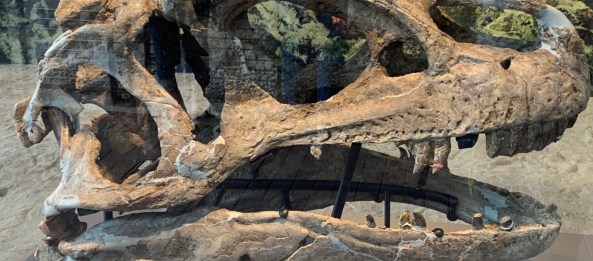
Visiting Dinosaur National Monument

RGB Adventures visited Dinosaur National Monument on the Utah and Colorado border.  This was one of my favorite monuments I have visited so far in the last six months.  We spent three days in the park and we still did not have a chance to explore the northernmost areas of the park and missed the Gates of Lourdes…something for next time.  Perhaps because of Covid19, it was the least amount of people we have come into contact with in the national parks and monuments.  It was wonderful to have so many hikes and opportunities to visit petroglyphs by ourselves.  I highly recommend getting the first 9am appointment at the quarry and doing hikes by 7am.  Most people are not out and about yet and the sun isn’t beating down on you.  Also, the rangers still are excited to answer questions!  The temperatures are more in the 70s instead of the 90s. 

This blog and video are dedicated to the members of the National Girls Collaborative Project.  When I worked for Microsoft, I had the opportunity to join the champions board and volunteer for the organization for the last 10 years.  As many who know me are aware, I am passionate about encouraging women to undertake careers in engineering and STEM and that is what NGCP is all about with an amazing leader and great friend Karen Peterson!  I hope this blog excites girls to consider careers in the environmental sciences!

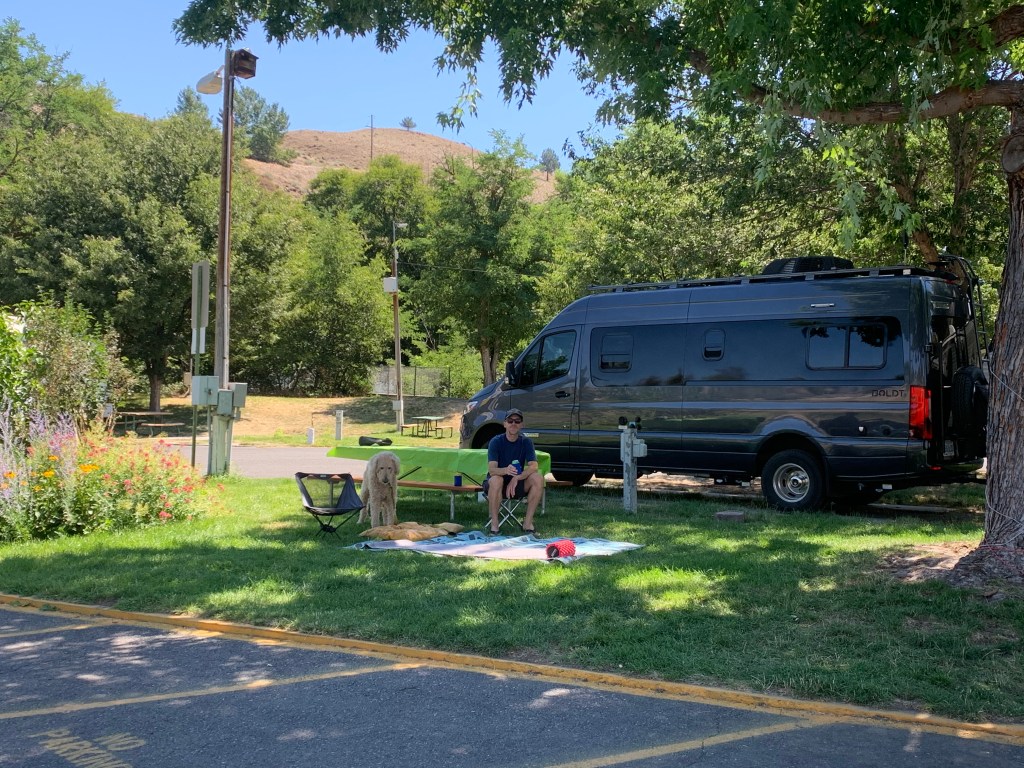
We started off by entering at the Jensen, Utah gate and went to our campsite at Green River Campground.  There were several first come first serve sites there so we did not have to make a reservation.   The next day, we got up early in the morning to hike through several petroglyph sites, enjoyed the amazing rock formations at the Sound of Silence 3.2 mile hike and instead of taking the tram we did the 1.2 mile one way discovery fossil hike to the quarry exhibit.  You must go online and make a reservation for the quarry due to COVID19, its only $1 a person. 

At the quarry there are park rangers and scientists who are geologists, archeologists, anthropologists and paleontologists studying these dinosaur bones.  Their research into ancient life helps us better understand earth and human life.  They have helped us better understand how different organisms interacted with each other and the environment and how its changed over time.  They are helping us understand the effects of climate change and how plants and animals are evolving. They also help us better understand why certain life goes extinct while others keep surviving.  If learning about these areas are exciting to you then you may want to pursue a career in Geology, Archeology, Paleontology or Environmental Science.

I had a chance to meet, talk and interview a park ranger who is a geologist and archeologist.  She told me that today the quarry is home to over 1,500 dinosaur bones and they encourage you in some places to touch the 149-million-year-old dinosaur fossils in the exhibit quarry.  It was exciting to hear her stories about the history of the park and the quarry.  The quarry contained eleven different species of dinosaurs such as allosaurusdiplodocus, and stegosaurus.  Check out the online multi- media exhibit of the quarry. When you see the quarry you wonder did paleontologists really discover the bones as they are presented, or did someone artfully place them here for effect?   Is this real or just a replica of what was in the past when they first dug up these bones? The answer is that paleontologists discovered the bones just where you see them today!  It’s incredible that everything in the quarry is real. The bones are just as nature arranged them more than 150 million years ago, deposited by an ancient stream.

The river coursed through a lowland area and dried up. Dinosaurs gathered around shrinking pools of water in the river bed and eventually died in place, to be entombed by sand and gravel when the river flowed once again. With more time, the river amassed large quantities of bones (like a huge graveyard, behind a dam). Layers of mud and sand began covering the bones, eventually hardening into rock. Here they remained, waiting for the next cataclysmic event and the explorers who eventually discovered them.
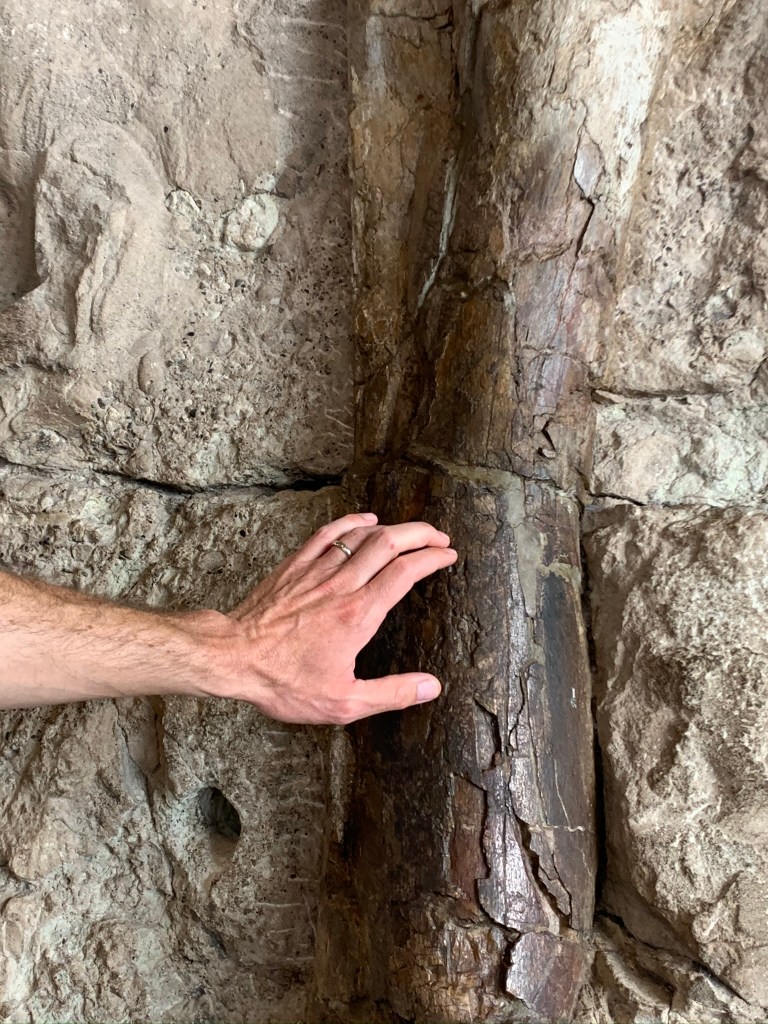
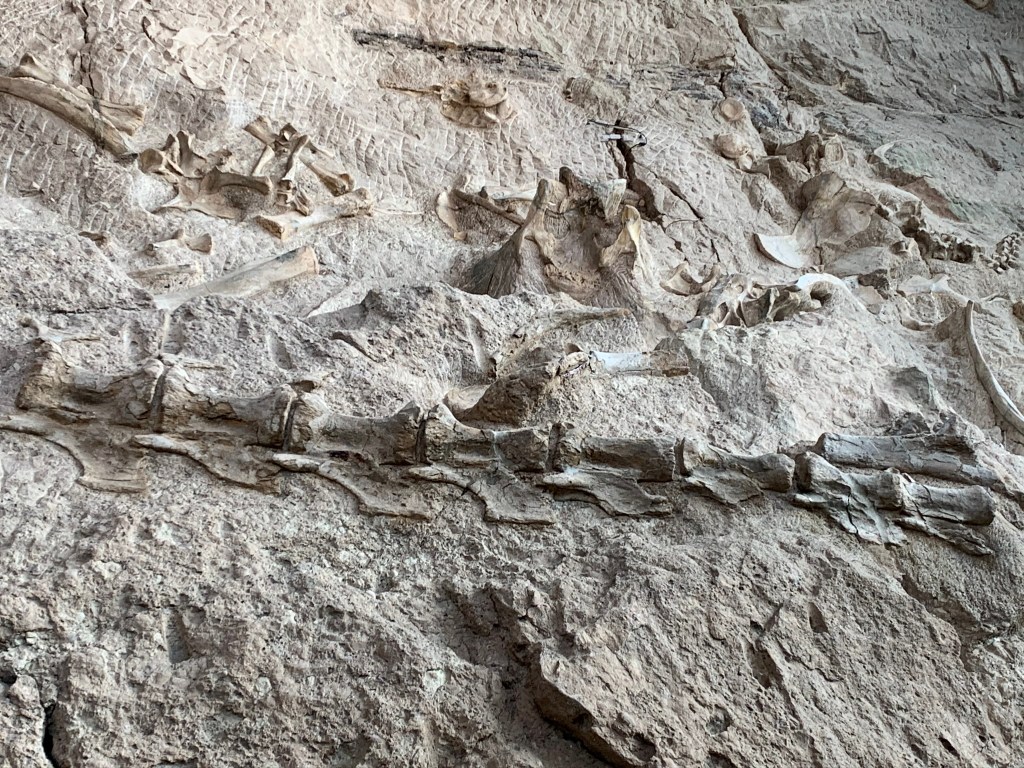
About sixty-five million years ago, that event began to occur. Forces beneath the earth’s crust began to exert themselves, forcing the crust upward, causing it to buckle and the riverbed containing the bones to tilt upward. Now near the surface, it was inevitable that erosion would eventually expose the bones and that one day someone would find them.  In 1909, Earl Douglas found the first bones of dinosaurs here as he was searching for fossils for the Carnegie Museum when he discovered a formation layered with prehistoric plant and animal fossils. A quarry was established and in 1915 Dinosaur National Monument was created to protect 80 acres in the quarry area as people were pilfering dinosaur bones. Today, the monument includes over 210,000 acres across two states. After this amazing experience, we returned to the visitor center via the discovery trail and by 10am it was already 90 degrees! 

We returned to our campsite only to be overrun with aggressive ground squirrels and chipmunks.  This is what happens when bad humans habitually feed the wildlife.  Bad humans!  So we headed to the River Access about a mile past the campground, to escape the little marauders.  It was relaxing to enjoy the Green River and admire the rock formations.  Let me tell you a little science behind all these different looking rock formations you will see in my video and below.
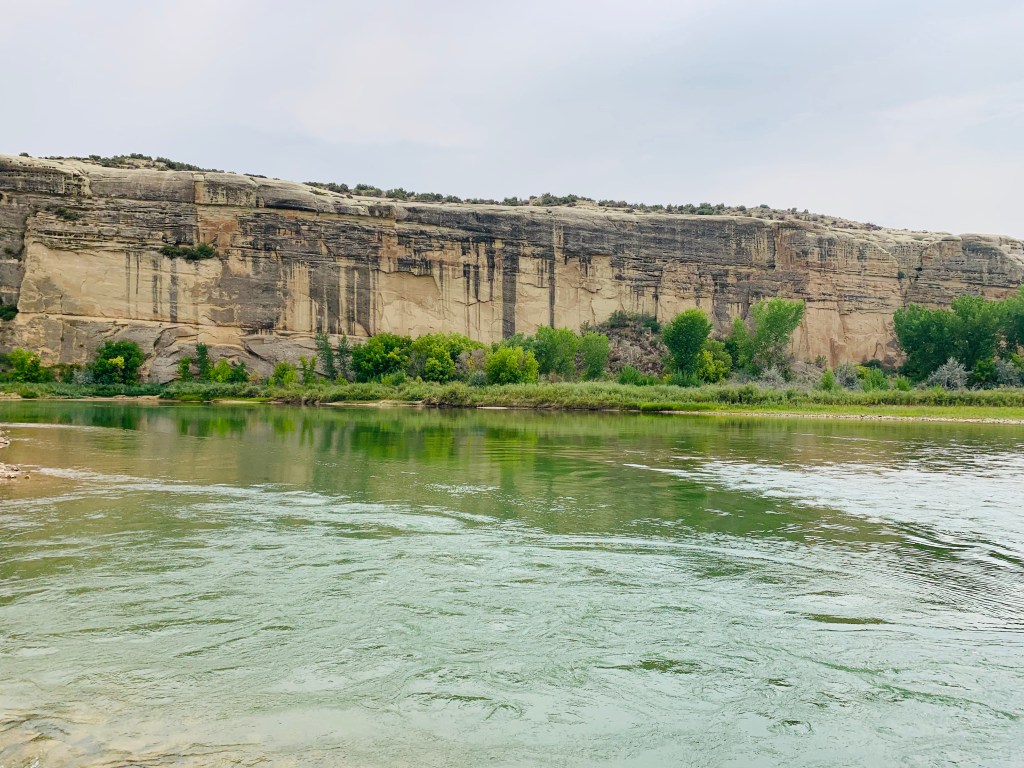
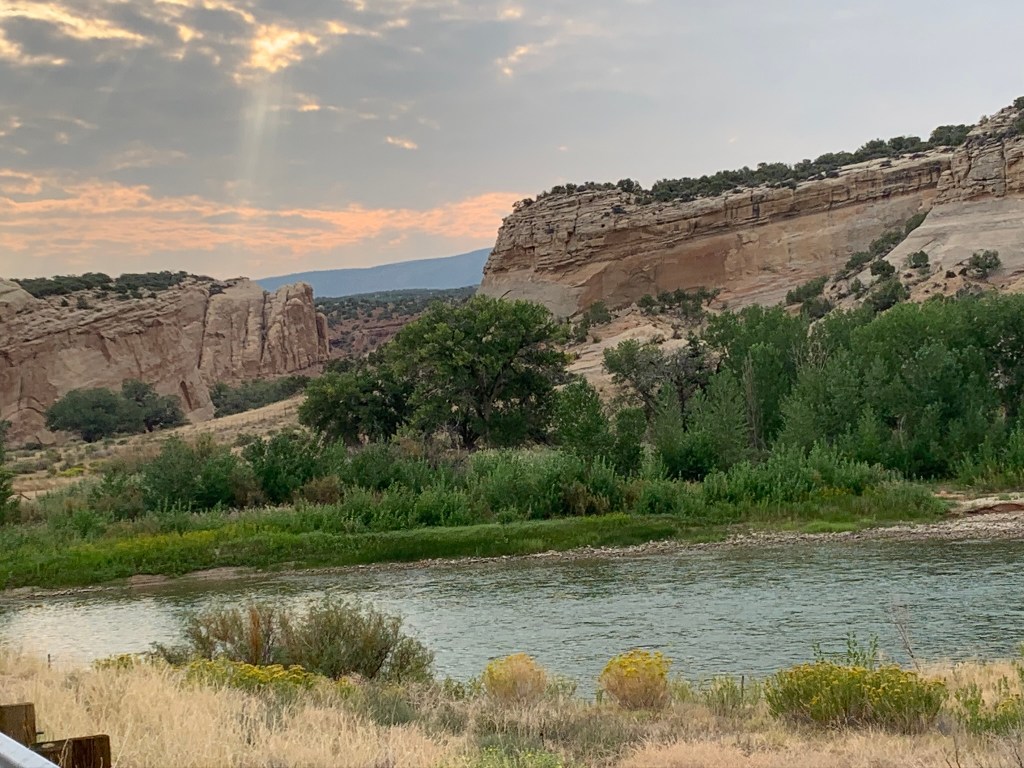
The geology and rock formations are amazing.  The following information comes from the National park Service.  Dinosaur National Monument receives less than 12 inches of precipitation a year, vegetation is thin and the rock layers and the geologic features are clearly visible.  Dinosaur is located on the southeast flank of the Uinta Mountains, a subrange of the Rocky Mountains and the highest mountain range in the contiguous United States that runs east to west. The landscape at Dinosaur was shaped by the development of these mountain ranges during the Laramide Orogeny, 70-40 million years ago.  Twenty-three rock layers are exposed at the monument. These rock layers are remnants of extinct ecosystems spanning 1.2 billion years, from ancient seas, to plains where dinosaurs roamed, to Sahara-like deserts that were home to tiny, early mammals. When the Rocky Mountains began to rise, this area went along for the ride.

At Dinosaur, the mountain-building did not simply push up the rock layers from below, but also squeezed them from the sides, warping and lifting them, sometimes cracking and shifting them along fault lines.

Throughout the monument, much of the spectacular scenery–the faults, folded and uplifted rock layers, and river canyons more than a thousand feet deep–reflect the tremendous geological forces that shaped this area.  You can see this at Split Mountain, the Sound of Silence hike (there is a virtual tour on my video of this hike) and the amazing canyon views on the Harpers Canyon Road in the Canyon entrance by Dinosaur, CO.  The Green and Yampa rivers are central to the extensive geologic history on display at the monument. Over millions of years, the waters of the Green and Yampa have cut deep canyons, exposing rock layers that were uplifted during the Laramide Orogeny.

The next morning before we left the monument, we road our e-bikes to visit two more petroglyph sites past the Green River Campground, hike Box Canyon and visit Josie Morris’s cabin (she was one of the first woman homesteaders in the area-you have to read about her amazing story).  Most petroglyphs in the monument came from the Fremont Indians, who lived in the canyons in and around Dinosaur National Monument 800 – 1,200 years ago. They were the forerunners of tribes such as the Ute and Shoshone, who still inhabit communities in the area today. 

Homesteading was a man’s world back in the 1900’s.  It was interesting to read about Josie defying the woman’s role as people knew it back then and paving the way for woman to own property. With no money to buy property, in 1913 Josie decided to homestead in Cub Creek in what is now the Dinosaur National Monument. Here she built her own cabin and lived for over 50 years in it mostly by herself. For a time, Josie shared her home with her son Crawford and his wife; grandchildren spent summers working and playing alongside Josie.
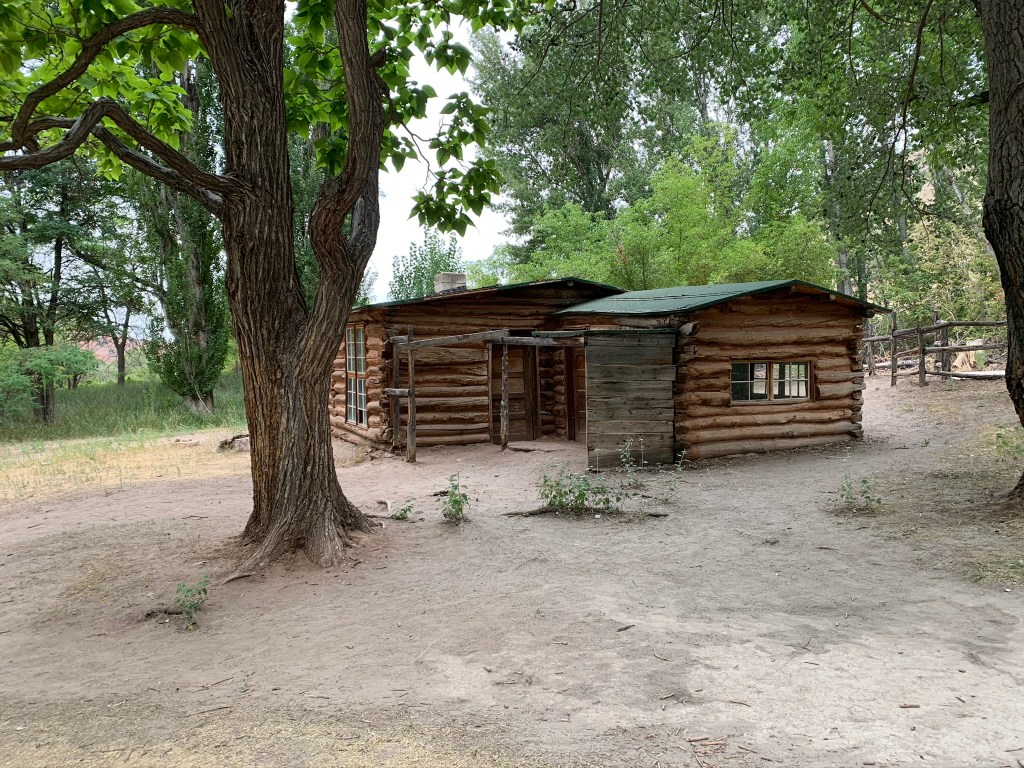
Raised on the frontier, Josie lived into the modern era of electronics. For friends and acquaintances in the 1950s, Josie was a link to a world past. During Prohibition in the 1920s and into the 1930s, Josie brewed apricot brandy and chokecherry wine. After a lifetime of dressing in skirts, she switched to wearing pants in her later years. She was tried and acquitted twice for cattle rustling when she was in her 60s. At the age of 71, in an ambitious move to revive a profitable cattle business, she deeded her land away and lost all but the five acres where her cabin still stands.

After our bike ride and hikes we headed out of the park and down highway 40 to the Dinosaur, CO Canyon Visitor Center entrance to see the canyon, change of vegetation and scenery.  It’s about 10 degrees cooler here because of the higher elevation.   We ended our visit by driving down Harpers Corner Road to see the Red Rock Canyon and Round Top Mountain and Island Park Overlook we were able to look down to the area we camped and explored which was an interesting perspective.  I recommend people of all ages to venture to this monument.  If you can’t make it, then you can watch our virtual tour.

Here are our top 5 things to do in the park:

  1. Do the tour of the quarry and if able the discovery fossil hike
  2. Hike the Sound of Silence during sunrise
  3. Camp at Green River Campground
  4. Check out the three Petroglyphs sites/hikes
  5. Cool off in the Green River at the River Access about 1 mile past the campground
Vanlife is Always Eventful

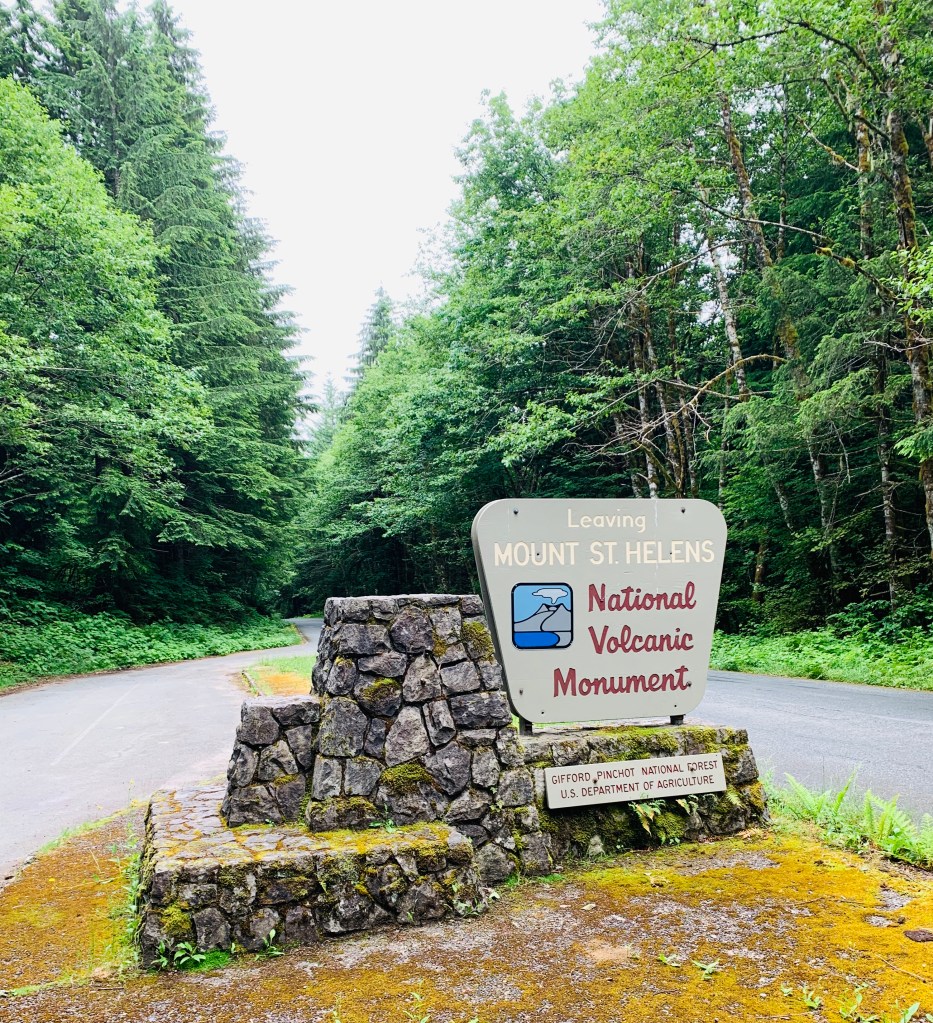
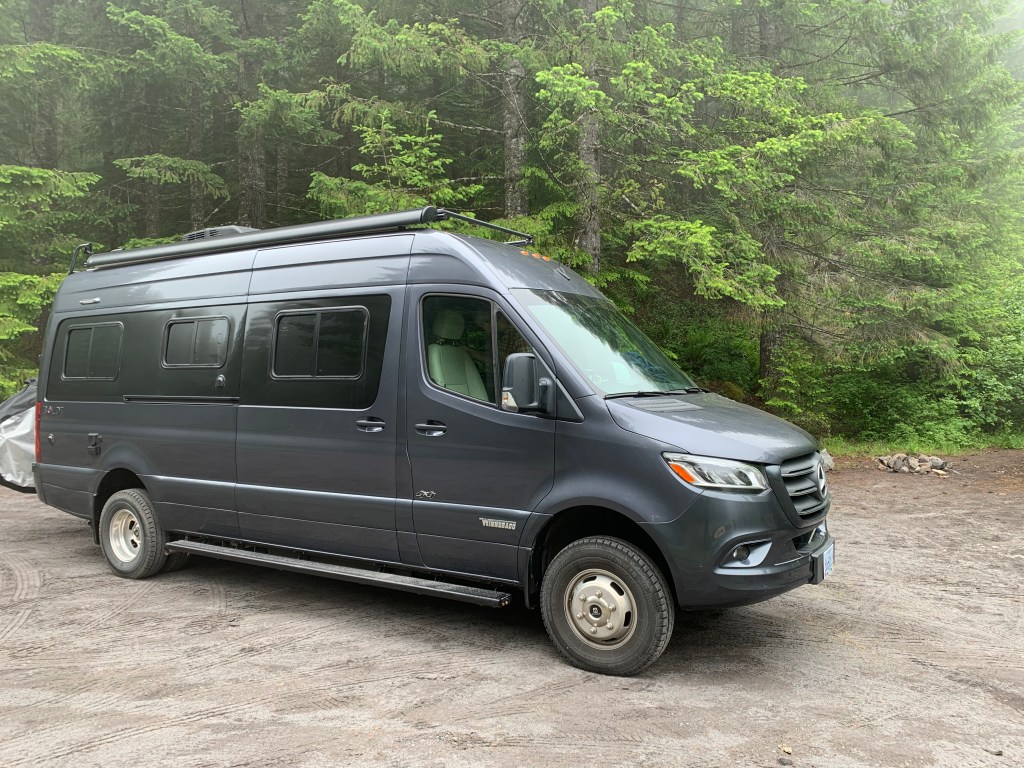
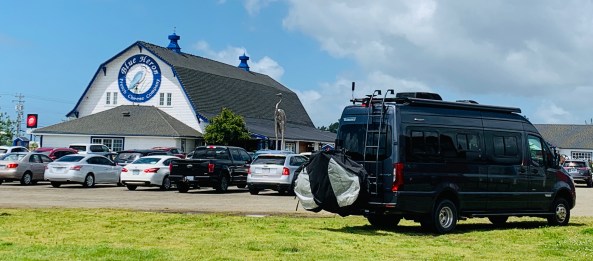
We have learned life on the road is always eventful and you have to expect the unexpected.  (For those who are visual here is our video for this blog.) We headed out of Newport, Oregon to go check out Mt. St. Helens National Volcanic Monument, Mt. Rainer National Park, Wenatchee National Forest, Sandpoint, Priest Lake, FlatHead-WhiteFish and Glacier National Park. First, we stopped by Harvest Host Blue Heron in Tillamook, Oregon on our way to Mt. St. Helens. As we arrived in Mt. St. Helens, we hit turbo fog and the reason we moved out of Washington to Central Oregon as the temperature drops from 75 to 60s and mist then rain hits us in early July.  We found a nice boondock spot about ¾ mile from Marble Mountain Snowpark and the June Lake trailhead.  We were hoping to hike up to June Lake and the rim of Mt. St. Helens but when we awoke to pouring down rain, fog and no view a few feet ahead of us, we decided it was time to head to Mt. Rainer and see if we can get above the rain clouds to some nicer weather.  As we were driving down and around Mt. St. Helens and up to Mt. Rainer we began hearing a loud knocking sound in our engine compartment.  Searching online what this could be we thought it is either the Mercedes Alternator or the Winnebago 2nd alternator that runs the house of our RV with the Volta Power System. Having zero reception, we kept one eye on our bars while we drove through Mt. Rainer National Park (still closed to camping as of July 1) to have enough bars to call Mercedes in Seattle. 

As you head to Mt. Rainer on Forest Service Road 2586 near the catch and release fishing sign and a bend in the river is a good possible boondock spot- there were no signs indicating no camping and a few fire rings. Another possible site is Northbound Forest Service Road 25 before MM 27 and near MM 24. 

The road to Mt. Rainer (FR25) is paved but is very rough.  There are many spots where the road is falling apart and disintegrating into the cliff.  It is very windy but quite beautiful.  Unfortunately, in the pouring rain and turbo fog we couldn’t see the views of the mountain or the overlooks.  As we reached higher and higher up the mountain pass the temperature dropped to the 30s with snow surround us.  We decided we’d rather not camp in the snow and went on to Issaquah to visit Greg’s brother’s family.  On our way, near the small town of Randle, WA we found a county rest area near a cute pound and wetlands area with a few Beaver lodges that allowed you to rest for 8 hours.  We took an 8-hour break here to have dinner, nap and rest before heading to Issaquah, WA.  We also had a few bars in this location to contact Mercedes Bellevue and get an appointment to find out what is wrong with our rig. Later when we got to Issaquah, we got a phone call from Bellevue apologizing for booking an appointment with us as they don’t work on Sprinter vans and we must go to Seattle Mercedes.  Thankfully, Seattle Mercedes could see us at 8am on Thursday, July 2. 

Greg got to Mercedes at 8am and found out several techs took personal days for the 4th of July holiday and they may not get to our rig!  (Never break down before 4th of July holiday!)  after several disgruntled phone conversations with the service manage finally, by end of the day, we find out that the engine and alternator in the Mercedes were good but It was the 2nd alternator that Winnebago and Volta put in that is dead.  Of course, its 5pm Thursday.  Winnebago is closed for the holiday, Volta is closed for the holiday and every Winnebago service center is booked solid so we have to stay in Issaquah until Monday as we need to be plugged into to shore power to be able to use our rig.  After spending all day Monday on the phone with Winnebago, Volta and contacting every Winnebago service center in the Washington area were all booked solid for the next 3 weeks, we get approval for Mercedes to put in the alternator and for it to be overnighted.  So on Wednesday, July 8th, Greg heads back to Mercedes Seattle to get the 2nd Alternator installed and hopefully all our issues go away. 

At noon, Greg arrives at his brother’s house and it seems like our issue is fixed.  The Volta system is green, the engine knocking sound is gone.  So, we pack up and head to Wenatchee for some much-needed sun and warmth!  After a few hours of driving we notice our batteries are not charging, so I begin texting back and forth with the Volta technical support technician as they think Mercedes has damaged the system when installing the alternator.  We are now 200 miles away, we decide to boondock at Washington Fish and Wildlife Area Watt Canyon, (near Ellensburg, WA) which is a nice, picturesque spot and next to a pretty irrigation canal.  We parked in a fairly flat gravel parking lot and if we weren’t exhausted from all the vehicle issues, we would have mountain biked the area, there are miles of gravel roads to explore in the area.  In the morning, we were down to 70% and no charging of our batteries.  We then called around a dozen Winnebago service centers in Washington, Oregon and Idaho who are all booked out for the next 2-3 weeks and they couldn’t fit us in.  Finally, Volta Power Systems came through and found us a service center in Eugene, Oregon that could see us and are certified technicians of the Volta power System.  So as we were headed towards Idaho, we needed to do a course correction and began heading Southwest and 400 miles out of our way to get our rig fixed.  At least, Oregon Motorcoach Center owner Matt Carr was super empathetic, helpful and tells us as soon as we get here, he will help us out!  He took the time to talk to Volta technicians and Winnebago to ensure we are taken care of and that all the parts that could be needed were at his shop!  YEAH, someone good, we hoped!

We decide its time to use our Harvest Host membership and head to Zillah, WA to stay at Bonaire Winery on the way to Oregon. They are super friendly, beautifully landscaped property and yummy wines that are currently 50% off because of COVID19.  We enjoy a lovely bottle of chilled Rose Syrah paired with instant pot lentil soup at dinner.  The next morning, we awoke to our breakers beginning to trip as we try and use the microwave and stove for breakfast with our power down to 60%.  We decide its time to take the big push and drive over 250 miles from Yakima Valley to Eugene.  At 2:30pm, we arrive at Oregon Motocoach Center to Matt taking good care of us and getting us parked, plugged in, discuss the issues and offer us to use their barbecue gazebo area for the weekend and 730am Monday morning he would get our rig fixed.  After an hour being plugged into shorepower we are back to 100% and some relief flooded our bodies!  We grilled a couple of steaks and roasted vegetables on their grill and finally enjoy a couple beers, AC and some Jimmy Buffet Cheeseburger in Paradise!

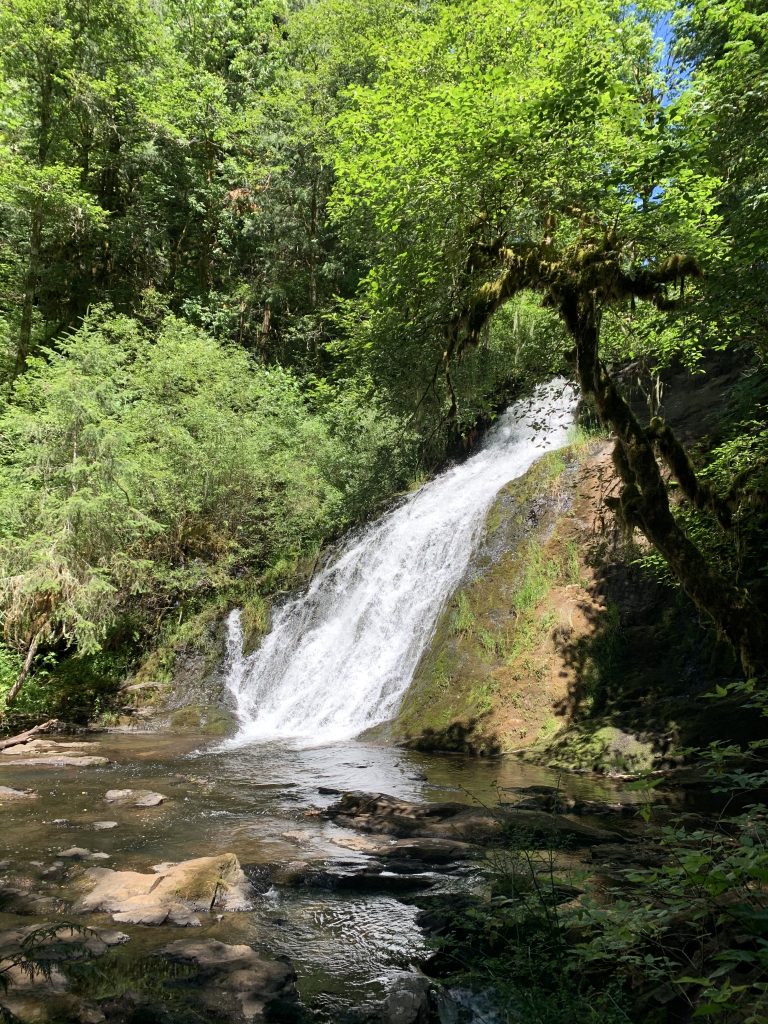
When life gives you lemons you must make lemonade, so on Saturday morning we decided to head to our beach house in Newport to get a few errands completed and see the beautiful countryside and boondock in some pretty places on the Oregon Coast since were fully charged. We took the back-country roads from Eugene to Philomath that are so stunning and relaxing with very little to no traffic.  We highly recommend this route (follow Territorial Highway and Bellfountain Road).  After finishing our errands, we took a couple hours to relax at Seal Rock and watch the sunset and cook Instant Pot Split Pea Soup (I’ll have a blog soon on my favorite Instant Pot recipes).  After the beautiful sunset we took the back road Highway 34 towards Alsea Falls and boondock in the Siuslaw National Forest near the Old Strawberry Farm.  This part of the Alsea River is gorgeous and very green with a very rainy spring bringing lots of new growth.   In the morning, we headed back down 34 and backroads to Alsea Falls for a hike, mountain bike and check out the campground and BLM dispersed camping opportunities for the future as we headed back to Oregon Motorcoach Center.  Note there is no reception in this area. 

First thing Monday morning at 7:30am, they took out rig and started testing systems.  We found out that Mercedes Seattle installed the alternator wrong and it shorted out the 2nd alternator and shorted out the main Volta Power System brain and they would have known they did this, as the technician must have been electrocuted.  After hearing this, we thought great it is going to take at least another 2 days as another alternator would need to be shipped.  With COVID19, we were seated outside and it was about to hit 90 degrees, so we got a rental car and hotel for the night and more phone calls to Winnebago to ensure we get the parts we needed.   As we were trying to relax at the hotel, we got a phone call from Volta ensuring us that everything will be fixed and it was under warranty and we would not be charged. They promised they would make sure the system is working properly and fully tested before we left Oregon Motorcoach Center.  It was great to hear their attention to our situation and ensuring that our system will be 100% before we left.  Then Oregon Motorcoach Center called that they were done and that they had an alternator and a Volta System Brain in stock they used to fix our system.  Since it was already 3pm and we were already checked in to the hotel, we agreed to come first thing Tuesday morning to get a walk through and pick up our rig. 

The technician walked us through everything they did and what to look at if something goes wrong again.  We decided to head back to Alsea Falls Campground and stay there for three days and test the system.  After three days our system did not trip any breakers and was down to 25%, we then headed to Harvest Host Summerfield Winery on the edge of Springfield/Eugene area off Highway 58 for the night.  It charged back up to 90%, yeah so far so good!  The owner Cris is wonderful and she gave me a lovely wine tasting and we enjoyed a bottle of Pinot Blanc and a bottle of Pinot Noir to enjoy another day.  Cris was so friendly and she chilled the bottle of Pinot Blanc for us.  The next day, we headed down 58 which is a beautiful route with very little traffic, such an enjoyable drive.  We should have boondocked at Salt Creek Summit Snow Park but I used Google satellite view and saw RVs parked at Black Rock Pit so we decided to go there to get further Northeast.  I was totally wrong and there was no public entrance but a locked gate.  So we headed further North and boondocked for the night in the national forest near the Sunriver exit off I-97.  There must have been a last-minute cancellation and we were able to get one night at La Pine State Park which was great as there are lots of hiking, running and mountain biking trails to enjoy and the beautiful Deschutes River.  It was flowing pretty fast so I did not pull out the paddleboard.  The next day we headed to Cove Palisades State Park.  We were surprised to see there was availability in the Summer in Loops A, B and C.  Note: DO NOT STAY at Loops A, B or C (called Deschutes campground) there are no views, no hiking or biking trails and no shade- its super-hot and not very interesting!  You want to stay at loop E (crooked River Campground) It has trails, is closer to the Day Use area and a much nicer campground.  We typically never do full hookups but we were super happy that we did as the temperatures go to 98 and as it was the first time, we ran our AC all afternoon, evening and night! 

We were happy to head out at 5:30am the next morning and stopped at the Maupin City Park.  It is an amazing spot, great shade, full hookups and a dock to paddleboard or swim or put in your kayak or raft.  It is quite spendy at $48.00.  I enjoyed a paddle on the river and we relaxed with beers in the shade with our awning out.  While at Maupin we met the City Park Manager and her husband the Maupin City manager who are super friendly and wealth of information! If you want a guided trip down the Deschutes feel free to contact Forward Paddle which is managed by Greg’s cousin The next day we went for bike rides on the Deschutes BLM Access Road.  We then found in the next 6 miles 6 different primitive campgrounds that were only $8 during the week $12 on the weekends and 50% off for Access and Golden Passholders. Next time, when we don’t need AC all night we will definitely stay at one of those.  During the week, they all had available spots.  I would not recommend anything over 32 feet the spots are small. 

The next day we reached Bonair Winery again and could begin our track to Idaho and Montana.  Those stories to come in the next blog.  So here are your call to actions:

  1. If you hear an engine knocking sound go to Mercedes first and make sure nothing is wrong with your engine.
  2. If its your second alternator call Volta Power Systems first and have them help you find the right Winnebago Service Center that has a certified Volta technican
  3. Then call Winnebago customer care to get warranty to cover it and work with Volta and the service center to get all the necessary parts. 
  4. If you have to get a service center that doesn’t have a Volta certified technican make sure they call Volta technical support first before installing your alternator so they unhook power, turn of system and install it correctly!
  5. If you aren’t a Harvest Host member and want a 15% discount here is our link and here are the websites of Bonaire Winery and Summerfield Winery.
  6. Here are the websites for La Pine State Park and Maupin City Park.
  7. Here is the website for Forward Paddle if you want to do a guided trip on the Deschutes River
  8. Here is the link to the video for this trip.

On the Road to Eastern Oregon

We are back on the road, yeah!  As Oregon and much of the USA is starting to re-open and even in some places in phase 3 of 4 phases of re-opening, it seemed we would be okay to head back out. Plus, Newport allowed vacation rentals to begin hosting guests again, so our beach house has been rented and we need to move on before guests arrived.  Before hitting the road, we called several BLM, Forest Service and state park offices and they all said YES, WE ARE OPEN, so we headed back out on June 8th.  We decided it was time to explore Eastern Oregon, being Oregonians most of our lives it is a shame we haven’t explored it more, so here we go. We like to limit our daily driving to less than 125 miles, so we took our time heading toward Eastern Oregon.

As we left the coast, we stopped first at a nice boondocking spot on Highway 20 after Sweet Home by the Willamette National Forest sign, past Cascadia Campground but there was zero cell coverage and we needed to make sure our guests got in okay.  After dinner we headed back up Highway 20 east past Tombstone Pass where there is a nice snow park (Lava Lake) with cell reception that we boondocked for the night.  The next morning after breakfast we headed to Bend where we took a friend’s advice to boondock on BLM lands near Pine Mountain Observatory.  It is very secluded, pretty much just sage brush, cows and miles of pretty rough dirt roads (we call is moon dust because it is fine and just gets into everything).  If you like seclusion you will like this area, we got a little tired after driving 10 miles on rough dirt roads before we could find a good pull off stop.  We’d suggest boondocking at the big flat parking lot by the Badlands instead, as its super easy and not far off Highway 20.  We saw several RVs stopped there and the Badlands is a great place to hike with your four-legged friend.

The next day, we stopped at Chickahominy Reservoir which is a great BLM camp spot for only $8 a night/ $4 for Golden and Access Pass holders.  There are several waterfront sites (28 total sites), they are spacious and dispersed a good distance between each other that you feel you almost have the lake to yourself.  It is stocked twice a year with rainbow trout and there were several anglers fishing the banks and in boats.  The location has a fish cleaning station, picnic tables, fire-rings, drinking water, trash cans, vault restrooms and a boat ramp.  We enjoyed this spot for a couple of days and did bike rides and runs around the reservoir.

We then ventured to Chukar Park near Juntura, Oregon another BLM camp spot which was only $5 a night/ $2.50 Golden and Access Pass holders.  It was more primitive, with just picnic tables, fire rings, vault toilets and the water wasn’t turned on yet when we were there.  It is set next to the Malheur River but its very overgrown so you can’t see the River, there are nice full sun and shade sites depending on your interests.

Next, we boondocked about ¾ mile past Snively Hot Springs in the Owyhee Wilderness on Snively Gulch Road.  It is a fairly even and flat gravel area along the Owyhee River that leads to the Owyhee Reservoir.  We stayed there a couple of days and only ventured to the Hot Springs once, as it rained so much that the water was really muddy and not to appealing.  The hot springs felt great and there are two pools one quite hot and the other more luke warm.  We decided to head up to the state park and check out the main campground by the dam.  There are many boondocking spots along the river all the way to the dam, the road gets very narrow and up against steep cliffs with a lot of rock falls (we saw a rock fall on the vehicle ahead of us).  It gets a bit stressful as there are a lot of large trucks hauling boats and 5th wheels and barely enough room to pass each other in many spots.  The state park campground is nice with 67 campsites at McCormick Campground and then Indian Creek Campground around the bend both  having full electrical hook ups and tent primitive sites, with showers, bathrooms, trash, fresh water, dump station, fire rings and picnic tables.

We had a lot of wind and rain for June so we decided to head to some sun and heat in Idaho and ventured to Morley Nelson Snake River Birds of Prey Conservation Area outside of Boise, Idaho.  Do not take the short route on Google Maps that goes directly to the boondocking spots it takes you to private property and you cannot take the road through.  You need to go through Kuna and down Swan Falls Road, a much better route.  Idaho Power actually maintains 18 campsites even with trash cans with picnic tables and fire rings, we saw an employee every morning going to and cleaning out camp spots. Please be a conscientious camper and don’t dispose of trash that does not burn or cans in firepits as there are dumpsters just up the road at the dam and boat ramp. After the 18 they maintain then it turns to BLM camp spots that are not very well maintained and are more primitive.  The road is a mixture of hard dirt and gravel, there are parts that are very rutted out.  I would recommend 4X4 Class B and C and smaller truck trailer RVs.  We were surprised to see a Class A size 5th wheel make it down the road and into one of the sites, I wouldn’t recommend it though unless you are very confident about your driving skill and rig.

You may stay here free for 14 days, it’s a beautiful spot on the Snake River and amazing wildlife to view. We saw so many birds of prey (falcons, hawks, eagles, osprey, pelican), coyotes, lizards, a rattlesnake or bull snake, jumping bass and deer, the wind is super strong here.  There are rattlesnakes so watch out!  We ran into a baby snake in our camp, ground squirrels and there are ground hog like looking animals everywhere.  It is also a popular place for locals to rock climb, fish and play in the river.  Watch out for some fast vehicles going down the dirt road if you are biking or running.  We hope you may enjoy visiting these spots.  Below are hyperlinks to the descriptions and GPS coordinates from freecampsites.net.  Next week, we will tell you about our stay in the McCall, Idaho area and our request from our subscribers to help us plan the rest of our Summer and Fall travels.

  1. Tombstone Snow park
  2. Badlands by Bend, OR
  3. Chickahominy Reservoir
  4. Chukar Park
  5. Snively Gulch Road
  6. McCormick Campground
  7. Snake River
  8. Check out our video of this trip!