The process of building a yurt can be long and complicated, with many hurdles to overcome along the way. In this blog, I discuss our journey as we try to build our yurt on a piece of land in Sandpoint, Idaho. We had to navigate complex regulations and permitting processes, find reliable contractors, and deal with soaring wood prices during a time of high demand. Despite the challenges, we persevered, were ultimately able to complete our project and hope this helps you not make the same mistakes we made.
Once we ordered our yurt on June 28, 2021 we had until August 28th to get our property ready. The first thing we did was apply for an address with the county and the US Postal Service, as an address is required for many aspects of property development. Next, we visited the local library to research permits, regulations, and costs associated with developing an off-the-grid property. We looked into well-drilling, solar panels, grey water systems, platforms, and composting toilets. We researched the best composting toilets that did not require plastic bags since we wanted to maintain our eco-friendly lifestyle.
To our surprise, we learned that preparing non-developed land for development requires a lot of work, and it is not as easy as we initially thought. We assumed that there would be very few permits needed in Idaho, especially since our property was outside city limits and not subject to CCRs or HOAs. However, it seems that Idaho requires just as many permits as just about any town on the West coast. The advantage of living in a small town is that you can obtain the permits much faster than big cities if you take the time to meet with everyone in person and you live on your property full-time during development.
One of the biggest challenges we faced was drilling a well. We learned that the average cost of drilling a well was between $15,000 to $35,000, depending on the depth. After speaking with neighbors in the area, we found out that we would spend a minimum of $25,000 on drilling a well. We contacted several well contractors, but they were booked out for 18 months. Moreover, locals warned us about issues they faced with their wells, such as drying up due to new development and needing to be redrilled, with additional costs of $5,000 to $10,000. We decided to connect to the local Syringa Water District instead, which would cost us about $6,000. We filled out the necessary permit requirements and attended a local board meeting to request that three adjacent neighbors get water on our property on the North Idaho version of fast track. The board was understanding and promised to get us connected in the next 2-3 weeks, just in time for our Labor Day weekend yurt-raising.
We also discovered that due to the long, grey winters in Idaho, we would not generate enough solar energy to power all of our electrical needs. The better option was to connect to the local electricity grid and send energy back to the grid during summer months when there is a surplus of power. This is referred to as a net metering system. Therefore, we decided to connect to the local electricity grid and natural gas line, as I love cooking with gas and we might get a gas fireplace in the future. This required more permits and applications with the local utility company (AVISTA). Fortunately, AVISTA was understanding and worked with us to meet our short deadline so that we could get all utilities in, concrete poured, and set before September 1. Don’t forget the solar permit is a different permit from your electrical and before AVISTA will turn-on your net meter, they need the approval from the state inspector. You need to find an electrician who will dig your trenches (if you don’t want to), lay all electrical cables, meter install and transformer. There are forms your electrician must submit to AVISTA on your behalf.
To obtain a site building permit, driveway permit, water, electrical, solar, and gas permits, we needed a detailed site plan. Fortunately, I had taken architectural and technical drafting in high school, so I was able to create one. We measured everything precisely, ensuring that we were 25 feet from the property line and had a 7.5-foot utility easement. We measured the length of our road, the distance between each corner of the property lines and our yurt, and the dimensions of our patio, which we put on the permit. We learned that it is important where temporary property line markers are to put up metal property line markers (you can purchase at Home Depot, we bought the 6 footers and used a stake driver to place them in the ground). You don’t want to have to pay for a surveyor when wildlife, trees or snow knock them down. (Note: You will modify this many times, do it in pencil, and be ready to modify it with contractors and inspectors onsite and you can take a picture and send it immediately while they are onsite.)


I had initially planned to install a Sun Mar composting toilet in our yurt and had found a cabin-on-wheels company in Spirit Lake, Idaho that sold them. However, due to the state’s regulations, we were not allowed to have a composting toilet and direct city water in the same dwelling. Instead, we were required to install a grey water system, which was a large concrete tank with a pump that filters the grey water and only allows us to use the water to water trees. After researching various solutions, I found Hydra-Loop, which had innovative technology to filter our grey water so that it could be reused for watering trees, gardens, and even for washing clothes. However, we were told that Hydra-Loop wasn’t eligible by Idaho DEQ standards and we would need to contact the company to get approved before we could use what I was suggesting. The company was willing to go through the application process, but it would take over a year, which was too long for our 3-month deadline. Therefore, we opted to give up on our composting toilet and grey water system and instead applied for a traditional septic system, which would cost us almost the same amount.
Oh well, best laid plans!
While researching all the regulations and permits required, we were also trying to find a contractor to build our yurt deck platform, make our driveway, and do all the necessary trenches. We had to consider various factors such as the distance between the water, electric, and gas trenches and the most logical spot to put them to make it easy to dig up in the future if there were any issues. (Note: Water, gas and electrical lines can’t be in the same trench). We also had to consider the opportunity to share costs with our neighbors who were also putting in their water, gas, and electricity. After multiple revisions to our site plan, we finally found a solar guy who was an electrician and could do our electrical trench, put in our electrical meter, and do all the yurt electrical. We also managed to secure a plumber and someone to do a gravel pad for our shed and driveway, but it was a challenge due to the high demand and escalating costs for contractors.
During this time, we were living full-time on our property in our truck camper, which made it easier and more convenient for all the inspectors and contractors to stop by. We were working tirelessly in the hot summer to limb up all the trees in the area of where the yurt would be built. Our five acres had been previously logged, and there were dead limbs everywhere, so we had to create six huge burn piles of dead limbs over the next three months. It was exhausting work, but we were making progress. One day, while taking a beer break, one of the driveway contractors drove by and asked if we needed a gravel pad. He was about to finish a job and said he could come over in 15 minutes to give us an estimate. After talking with him, we were able to secure his services, and things were finally falling into place.


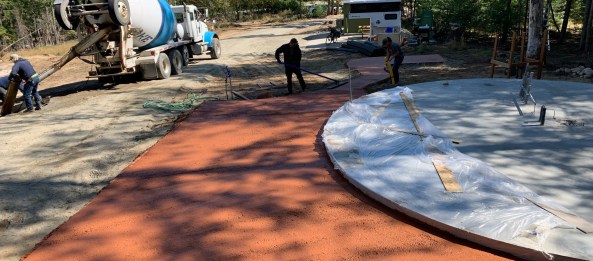
As mid-July approached and trenches were being dug for water, gas, and electrical lines, we knew we needed to make a decision on our yurt platform. We searched online for platform plans but ultimately decided to do it ourselves, calculating the costs of timber, cement bases, and various materials needed. We also began obtaining quotes from septic contractors. Fortunately, my childhood best friend’s dad, who owned one of the other 5-acre parcels near us, had already researched septic costs and feasibility before purchasing the property. We contacted several contractors, one was available and provided us with a bid for all the necessary work, including trenches, septic installation, and driveway construction. After some discussion, we agreed to have a simple cement pad for the yurt and a cement patio, which would be less expensive and lower maintenance than wood. The contractor went to work prepping our property.


It is important to note that before purchasing a property that requires a septic system, a perc test should be conducted to evaluate soil drainage. The perc test helps determine the best location and size of the septic tank and drain or leach field, which distribute treated wastewater into the soil. If the property fails the perc test, a septic system cannot be installed. It is also important to build your home/yurt above this spot to take advantage of gravity and avoid the need for a pump house.
As someone who loves to cook, a real kitchen was important to me. We ordered all the necessary appliances (stove, refrigerator, washer/dryer combo) cabinets, countertops, bathroom sink, kitchen sink, toilet/bidet combo (saves on toilet paper), shower, hot water heater from Home Depot and Selkirk Glass and Cabinets. It takes around six weeks to receive all the necessary components, so it is crucial to give yourself ample time to have everything ready for installation. We were able to store most items in our shed until the yurt was built.
By August 25th, we had completed all necessary preparations and were ready for our yurt materials to be delivered on September 2nd, with our crew of friends and neighbors scheduled to arrive the following day for the yurt raising. In our next blog, we will discuss how to organize a yurt raising party and what it takes to raise a Weatherport 24’ yurt. But first, some lessons learned.
Lessons Learned:
- Be nice but persistent! If you live in a small community, take the time to meet all of the permitting officials in person, be super friendly, and do everything they want on the spot. Several times, officials made changes to our plans while on-site, and we made sure they were happy before sending the changes with them or via email. Being nice is critical, as you are the one with deadlines, not them. Being rude or mean will not help you, as they can ignore you and move on to the next person. Many officials expressed their appreciation for working with us because we were organized, had everything filled out properly, were nice, available, listened, made necessary modifications, and tried to make their jobs easier. When a permit was taking longer than expected, we gave a friendly nudge via voicemail or email.
- Live on-site! With so many people building right now, many are doing everything remotely. Officials and contractors appreciate your presence, as they can show you issues, and together you can make the necessary modifications and understand their concerns.
- Keep it simple! In the end, the simplest solution was often the best. Concrete was easier and less expensive than wood. However, it is crucial to remember that all plumbing, electrical, and gas lines must be laid before the concrete is poured. It is permanent and cannot be moved, so ensure that everything is in the correct place. Also, make sure your contractors are measuring from the same spot and clearly mark all your spots to avoid confusion. Have a detailed drawing indicating where sinks, toilets, showers, drains, and supply lines are being placed with exact dimensions.






 Encouraging the Minimalist Life