Hopping to Minneapolis to celebrate women in computing

impact    Going to a major conference is always fun. It’s an opportunity to see old friends and make new ones, to network with experts, and to be exposed to fresh ideas and trends. All those benefits hold true for the Grace Hopper Celebration (GHC) for Women in Computing, the Anita Borg Institute’s annual conference on women’s roles in computing. But for me, GHC is meaningful for another reason: it’s an opportunity for Microsoft in general—and Microsoft Research in particular—to focus on growing and retaining women in computer science and engineering. That’s why I am so pleased that more than 260 of my fellow “Softies”—including 9 executives and 22 women who will speak or lead at conference events—are joining me at GHC. This strong presence enables us to reach out to women at every stage of their technology career development, from students through established professionals, and to demonstrate Microsoft’s commitment to diversity and innovation in computing.

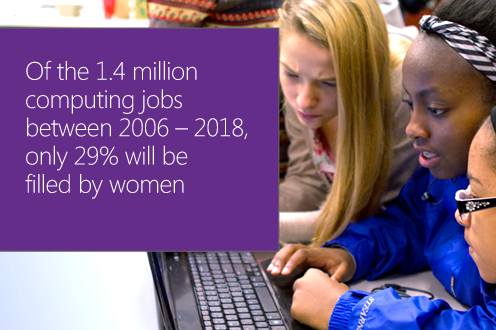
And make no mistake: such commitment is sorely needed. Women’s share of US computer occupations declined to 27 percent in 2011 after reaching a high of 34 percent in 1990. The US Department of Labor Statistics predicts that by 2018 there will be 1.4 million open technology jobs in the United States. At the current rate of students graduating with degrees in computer science, only 61 percent of those openings will be filled—and only 29 percent of applicants will be women.

The need is all the more critical when you consider that the latest advances in improving healthcare, protecting the environment, and upgrading manufacturing have come from technological innovations. At Microsoft Research, we recognize that such technology breakthroughs require teams that are sufficiently diverse to anticipate, respond to, and serve the needs of a changing world.

To bolster women’s participation in computing, we believe in a multipronged approach based on broad industry and academic partnerships. This approach builds exposure to computer science at an early age and supports women during undergraduate and graduate studies in computer science. Equally important, it promotes collaborations with the top women researchers and rising stars, such as the work I’m presently doing with Constance Steinkuehler of the University Wisconsin-Madison and Tiffany Barnes of North Carolina State University. We are researching the impact of exposing female middle school and high school students to computer science through an online community that teaches computational thinking via game design. In addition, Microsoft Research collaborates closely with Ruthe Farmer at the National Center for Women in Technology in the Aspirations in Computing and the Aspire IT programs. Constance, Tiffany, and Ruthe will speak in greater detail about these projects during my session on Innovative Solutions in Attracting More Women in Computing at GHC.

As part of our industry sponsorship, Microsoft is supporting 35 GHC scholarships. In addition, Julie Larson-Green, executive vice president of Microsoft’s Devices and Studios division, will be a mentor at the Senior Women’s Networking Lunch, and Jacky Wright, vice president of Microsoft Strategic Enterprise Services, will be speaking at and sponsoring the Women of Color Luncheon.
airstream

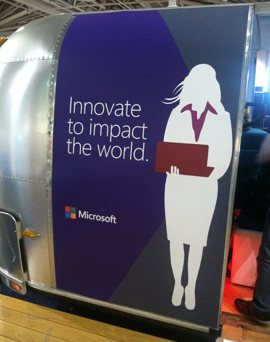
At the Microsoft Research booth—an Airstream trailer—GHC participants can check out the latest devices and learn about opportunities at Microsoft. If you’re attending Grace Hopper, whatever your professional affiliation or career stage, please stop by our booth (an Airstream trailer decked out with the latest devices) to learn about opportunities at Microsoft. Be sure to take part in our scavenger hunt—which offers Xbox and Kinect prizes—and the Dance-Off Challenge at the closing party we co-sponsor with Google each year. Through partnerships with businesses, organizations, and individuals, we hope to grow the next generation of women in computing. Let’s bridge the gap to future innovation together, through diversity and creativity!

—Rane Johnson-Stempson, Principal Research Director for Education and Scholarly Communication, Microsoft Research Connections


Concussion puts making a difference on pause

Hi folks, it has been a longtime since I have posted a blog and been online due to a concussion I had on February 23, 2013. I would like to take the time to help people understand concussions better and they are not something to ignore!

As the typical Rane, who thinks she is a robot that is indestructible, I got up from the 2 foot diameter puddle of blood on my hardwood floor and begun to tell my husband everything is just fine at 2 in the morning, as he thought someone was breaking into our home and kicking down our back door from the loud boom of me hitting the floor.  He cleaned me up (thank you Greg) and as I ran to the toilet to hurl a few times, I tried to convince him I was fine and we should just go to bed.  After keeping me a wake for a long while and ensuring I was not going to go to sleep and never wake up.   (for those who do not know, if you go to sleep after a concussion you have a good chance of not waking up again, so don’t do it!) He finally let me go back to sleep and head to the emergency room in the morning.   In the morning, I was ready to ignore the hospital idea and  jump on another plane and fly off to go change the world and grow women computer scientists.  My husband forced me to slow down, head to the emergency room and ensure everything was okay before I take on my next activity.  There, I found out I needed 9 stitches and that I had a concussion and should stay home and not do anything for the next few days.   I did not realize the sensitivity of your brain and continued on as business as usual, ignoring the doctor.  DO NOT DO THIS FOLKS!!!  I ended up making myself worse and could have healed a lot faster if I would have listened to him in the first place.

 Women Hack to solve Human Trafficking issuesI raced to the airport and headed to our first ever International Women’s Hackathon being launched in 7 countries and 14 locations around the world.  (Thanks to my husband driving me, later I would find out that I would not be able to drive for five months due to my lack of balance, memory and vision.)   It was a fantastic hackathon with over 600 young women all over the world programming to make a difference in proactively helping victims of human trafficking.  I on the other hand was not doing well with blurred vision, massive migraine headache and coming close to blacking out a few times.  I continued to move forward and then head to the Michigan Women in Computing Conference where I was the keynote speaker.  When I got about half way across the United States, my brain felt like it was going to explode and about 100 knives were being stabbed in my head.  I arrived in not too good shape but was taken good care of by the Michigan State University Team (thanks Laurie Dillon).  I gave the keynote and then flew back to Bend, OR to go get a CT Scan and MRI.  I then found out I had post-concussive syndrome (PCS) and if you don’t listen to your body you can’t try to solve the world’s greatest problems in computing because you have to focus on your health.  I knew nothing about PCS.

Post-concussive syndrome (PCS) is a set of symptoms that continues for weeks, months or even a year or more post a concussion.  It is a mild form of traumatic brain injury resulting in migraine headaches, difficulty concentrating, chemical imbalances in the brain, vision challenges, emotional and behavioral issues.  There is no treatment for PCS symptoms can only be treated  by medications, physical, vision and behavioral therapy and time.  In my appointment with the doctor, I could not balance on one foot, I failed memory tests and I was in the most excruciating pain from a migraine headache.  I learned I would now need to stop working, no more television, no more smartphone, no more computer, no more reading, I couldn’t drive, no more wine, no more caffeine and that I MUST REST– no ands ifs or buts.  For the first week, I could do nothing but lay in bed and then the next five months would result in only walks with my dog, listening to books on CD and knitting.  I spent the next four months with a migraine headache 24 hours a day 7 days a week.   My vision tracking dropped to a level of an 8-year-old.   If I had listened to the doctor in the first place it could have resulted in only a few weeks of recovery instead of five months.  DO NOT IGNORE doctor’s advice when you have a concussion it is serious!

I then got to spent the next four months spending time with three different doctors to try and get back to normal.  Learn to mediate, relax and calm the mind- an impossible endeavor for a Type A person.  I was surprised to learn there is still so much we don’t know about concussions and a lot of it is still a guessing game.  It also made me realize how illogical we humans are when it comes to our brain.  When we break an arm and leg we know we must rest it, not use it and give it recovery time, but with our brains we don’t ever rest it.  When you hurt your brain it needs to rest.  Resting your brain means no visual stimulation, no mental stimulation, plenty of sleep and rest, meditation is critical and necessary to heal.  Learning to slow down was very difficult but critical for me to finally heal and be able to go back to work.  Once I could read again, a few interesting books and research I read that may be interest to you, to help you through the siiutation if you get a concussion:

So now that it is all said and done and I am back to work, what I am I doing to ensure I don’t re-injure myself or what have I learned from this experience that may help other TYPE As or folks who have a concussion?

  • When your body needs to rest, if you won’t rest, it will force you to rest.
  • Life is too short to ignore your health and if you’re not healthy you can’t solve all the world’s greatest problems.
  • Your brain needs the same respect, rest and support you give any body part you sprain or break.
  • You can’t ignore the importance of work-life balance.
  • Don’t put work, volunteerism before family because in the end all you have is your family! (Thank you Greg, Pam, Gordon, Anne and Claudia for helping me through the last 5 months!)
  • Your not as important as you think you are, the world will move on, work will get accomplished and people will get things to work even when you aren’t around.  (Thank you to my amazing co-workers who stepped up and took so much of my work on!)
  • What you think must get done yesterday, can wait till tomorrow, even a few months.
  • Sometimes working slow is much better than multi-tasking and working fast!  (READ THE SLOW FIX!)
  • Lastly, I have a three-legged stool.  One represents global impact, one represents local impact and the last my family and self.  They must be in balance or I will fall off the stool.  If projects, opportunities & relationships don’t keep the three legs in balance then I must learn to say NO when one leg begins to become too long.  You can’t have a leg too long or you will fall off your chair.  It’s okay to say no, sometimes it is even expected!

I am truly happy to be back and I hope you look forward to the many blogs to come this year as I continue my passion to grow more women in computing!  At the same time I hope this blog helps you to take time to stop and smell the roses and take care of yourselves as you go on and take on so many challenges in your lives.

Innovators Wanted-Help The President!

I WANT YOU…. Anyone who grew up in the United States, as I did, is familiar with the famous World War II recruiting poster of Uncle Sam exhorting young Americans to enlist in the armed forces. (No, I wasn’t alive then, but the poster is an icon.)

I WANT YOU Uncle Sam Poster


Well, Uncle Sam is calling again, not for men and women under arms, but for recent graduates, top researchers, and great innovators—in short, for creative young people who want to be agents of change in the digital world. On February 5, the White House announced round 2 of the Presidential Innovation Fellows (PIF) program, a unique effort that brings incredibly talented go-getters from the private sector to work for 6 to 12 months with top government innovators to solve challenges of national importance. PIF projects are selected based on their potential to save lives, save taxpayer money, and fuel job growth.

Presidential Innovation Fellows

I am pleased to be working with the Office of Science and Technology Policy Team (OSTP) in helping to announce this second round of Presidential Innovation Fellowships, especially since the program complements my passion—familiar to regular readers of this blog—to grow the number of women and minorities in computing. The inaugural round of 18 Presidential Innovation Fellows worked on five projects and did a fantastic job, but, astonishingly, the group lacked diversity, even though the United States is renowned as a “melting pot” of cultural and ethnic diversity. For round 2, the OSTP wants to do a better job of reaching a diverse audience.

This second round of the PIF program include nine projects:

Disaster Response and Recovery: Collaboratively building and “pre-positioning” needed tech tools ahead of future emergencies or natural disasters, in order to mitigate economic damage and save lives.

MyUSA: Simplifying the process of finding and accessing information and government services that are right for you. Helping US businesses access the information and services that will help them grow, hire US workers, and export to foreign markets.

RFP-EZ and Innovative Contracting Tools: Making it easier for the US government to do business with small, high-growth tech companies, and enabling the government to buy better, lower-cost tech solutions from the full range of US businesses.

Cyber-Physical Systems: Working with government and industry to create standards for a new generation of interoperable, dynamic, and efficient “smart systems”—an “industrial Internet”—that combines distributed sensing, control, and data analytics to help grow new high-value US jobs and the economy.

Open Data Initiatives: Accelerating and expanding efforts to make government information resources more publicly accessible in “computer-readable” form and spurring the use of those data by entrepreneurs as fuel for the creation of new products, services, and jobs.

MyData Initiatives: Empowering the people of the United States with secure access to their own personal health, energy, and education data.

Innovation Toolkit: Developing an innovation toolkit that empowers the US federal workforce to respond to national priorities more quickly and more efficiently.

21st Century Financial Systems: Moving financial accounting systems of US federal agencies out of the era of unwieldy agency-specific implementations to one that favors more nimble, modular, scalable, and cost-effective approaches.

Development Innovation Ventures: Enabling the US government to identify, test, and scale breakthrough solutions to the world’s toughest problems.

If you are looking for an opportunity to make a difference, here is a chance to influence millions of lives by thinking outside of the box and building truly innovative solutions. Presidential Innovation Fellows have a unique chance to serve their country and influence change on a truly massive scale. The White House will be accepting applications from February 5 through March 17, looking to put together dynamic, diverse, and innovative project teams that will produce tremendous results for the residents of the United States.

PIF applicants need not have deep technical programming skills; rather, they require an ability to think creatively, be an agent for change, and to recognize opportunities where technology can solve problems. I am asking all of you in the academic community to reach out to recent graduates and alumni that you believe can influence positive change and envision innovative solutions. And don’t count yourself out, as this could be the sabbatical of a lifetime. If you are interested in learning more and applying, please visit Presidential Innovation Fellows.

Rane Johnson-Stempson, Education and Scholarly Communication Principal Research Director, Microsoft Research Connections

Learn More