Visiting Budapest, Hungary

So I am a bit behind in my blog, so I am going to try to catch up with my trip to Hungary, Serbia, Ukraine, Romania and TechEd Berlin.  My last three weeks have been a little crazy.  So first stop Hungary.  We have a great team of Zoltan, Peter and Judith.  Unfortunately, our team of three is severely understaffed and taking on more work possible for three people.  For a team of three they are doing an amazing job but have a lot on their plate to make significant strides and changes in the business.  With this launch wave of new products (Windows 7, Windows Server 2008R2, Exchange, System Center, Forefront, SQL, Visual Stoudio, Office 2010 and the list goes on), my lead Peter is doing so great outreach and creativity with helping IT Professionals get up to speed, improve their skills and have all the resources needed to help their companies save money and be more efficent.  What makes things very difficult is the current economy.  After long days and many meetings, a little about Hungary…  A great article from the Economist, talks about Hungary is on its way out of this recession just a little exceprt below for detailed article visit- http://www.economist.com/displaystory.cfm?story_id=14512527.   
 
AFTER years of crisis, Hungarians are used to belt-tightening. Although Hungary was among the European Union members that suffered most in the recession—GDP will shrink by 7% this year, just behind Romania and the Baltics—the outlook is now better, thanks partly to recent austerity measures.  The government has trimmed public spending by fully 3.8% of GDP this year, with most cuts falling on social spending and public-sector pay. These cuts came on top of earlier ones that reduced the budget deficit from 9.2% of GDP in 2006 to just 3.4% in 2008. More are on the way. The Socialist government, led by Gordon Bajnai, wants to chop an extra 1.7% next year to keep the deficit within the IMF-approved limit of 3.8% of GDP. It has also set up an independent fiscal council to monitor compliance with budget-balance targets.  The combination of these cuts and a big IMF loan is having a marked effect. The threat of a run on the currency has receded. The banks, mostly foreign-owned, have not collapsed, as many had feared. The forint is not quite back to where it was before the financial crisis but the central bank has felt able to start cutting interest rates.  What Hungary really needs is a review of all areas of public spending. A slimmer state requires big reforms. Yet the likely election winner, the centre-right Fidesz party, has spent the past seven years zealously denouncing even tiny reforms as sell-outs to fat cats or as disasters that would condemn the country to poverty. As elsewhere, Hungary’s underlying problems arose from wage rises unmatched by productivity growth and social spending that is too generous. It may be optimistic to think that, like the rest of Europe, Hungary has now learnt its lesson.
 
A liitle about the country- Budapest is the capital of Hungary and is split into 2 main areas: Buda-The hilly West side of the Danube (Districts I-III, XI-XII, XXII) and Pest-The flat East side of the Danube, covering the modern commercial core of the city(Districts IV-IX). Top sites:
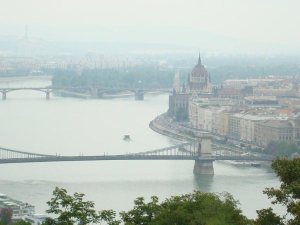
  • The Parliament Building (Országház). A neogothic jewel, beautifully situated overlooking the Danube. It is very much worth going inside, but you can only do that during guided tours, which are FREE (ignore those trying to pick you up outside the Parliament). Tickets for guided tours can be obtained each day from 8AM. You will have to go in front of the Parliament and queue at the ticket line. Again, ignore those that ask you if you want a guided tour. Just pick up your ticket inside and come back at the hour on the ticket. Guided tours in English are held each day at 10, 12 and 14.
  • St. Stephen Cathedral (Szent István Bazilika). The main church of Budapest is an important example of neoclassical architecture, recently renovated.
  • Great Synagogue and the Jewish Museum (Dohány utcai Zsinagóga) The biggest Synagogue in Europe, and the most impressive in the world. Next to the Synagogue is a small but impressive museum. In the rear of the Synagogue is a memorial for victems of the Shoah. The synagogue was recently restored to its former grandeur. A block away you’ll find a smaller, but nearly identical synagogue built long before the Great Synagogue. The plaque in front explains that this was used as some sort of assembly grounds for those persecuted during the Holocaust before they were deported. It has not been renovated, and you can see through the boards on the outside how decrepit it still is. A chilling sight.
  • The Royal Palace (Királyi palota). The most popular attraction on the hill. Very cool and there is a yummy wine cellar at the Palace- you must try….
  • National Gallery (Nemzeti Galéria) Inside the Royal Palace wings B, C and D houses an astounding collection of paintings.
  • The Fisherman’s Bastion and lookout terrace (Halászbástya). For impressive views across the Danube to Pest.
  • Matthias Church (Mátyás templom, aka Church of Our Lady). Dominant neogothic church crowning Budapest’s cityscape – nowadays is under reconstruction.
  •  
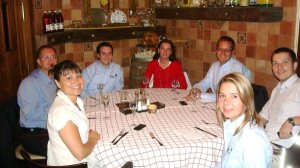
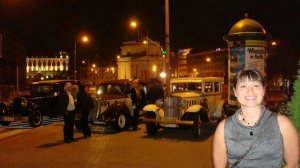
    Couple pictures from the trip:

    Visiting my team in Poland

    So last week I headed to Warsaw, Poland to see how my team is doing.  They went through a big transition from moving from one team (Maggie, Kasha, Mariusz) in one division of the company to another team (Karol and DPE team) in a different division.  It was also difficult as the new team has a different execution model than how my team is use to executing.  I would say each team member has a great plan but now they need to come together to build a cohesive strategy.  Almost there…After long days of meetings, planning, revising and negotiating we headed out to fun dinners to see the town.  The first night we headed to the Praga area and had a very yummy international restaurant where both old teams and new teams came together.  The second night we headed to a fun local place that was very angelic.  The food was fabulous and we had traditional polish favorites.  The last night we started at the roof top lounge where you could see the entire city of Warsaw and then allowed my boss Csaba join the ladies night out.  We took a nice walk from the Marriott to old town Warsaw.  We had Polish Tapas and Vodka at an old time Communist Era Bar.  We then headed to this cute restaurant that had over 50 different types of pirogues and special polish honey drink that was hot, alcoholic and very sweet! 


    Let me give you a little history of Warsaw.  Warsaw is the capital and the largest city in Poland.  It is located on the Vistula River (very beautiful) roughly 370 kilometers (230 mi) from both the Baltic Sea  and the Carpathian Mountains. Its population as of 2009 was estimated at 1,709,781, and the metro area is approximately 2,785,000.  Warsaw is the 8th largest city in the European Union.   On 9 November 1940 the City of Warsaw was awarded with the highest military decoration for courage in the face of the enemy.  Warsaw is also known as the "phoenix city," as it was completely destroyed during World War II, and rebuilt with the effort of Polish citizens.  It is an amazing town and the people are so very friendly.  I loved our taxi driver who had amazing customer service but was 3X the price of the regular taxi- oh-well.  Sometimes service is worth the extra charge.  I hope you decide to visit Warsaw.  A few pictures of the trip…


    By RaneRGBAdventures Posted in Travel

    1st Day of Oktoberfest

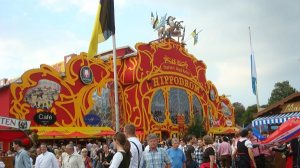
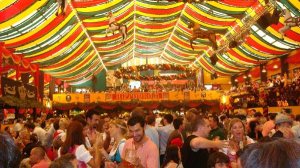
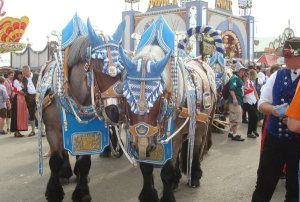
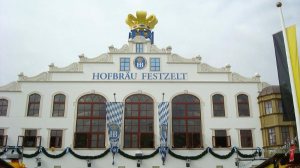
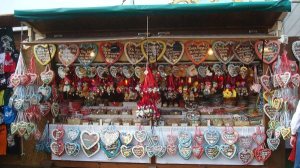
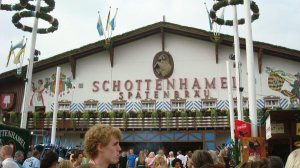
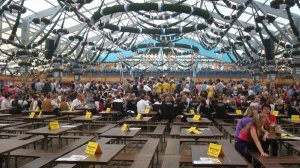
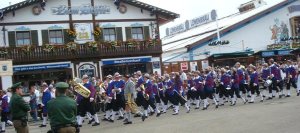
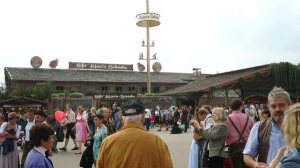
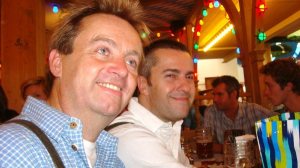
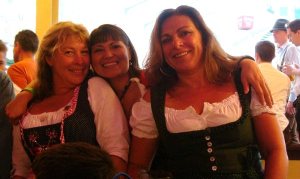
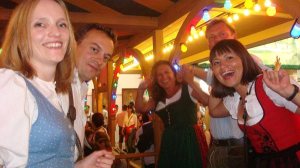
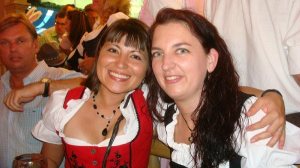
    So I headed to Oktoberfest today with my neighbor Bernie.  I should have known Greg was going to bail on me when he said he would meet me there at 13:30.   The wether was perfect not too hot, not too cold, no rain and not too many people- just yet that is…  We got there and walked around before meeting the Munich International Ski Club with our Box section Hacker Tent.  The tents are amazing, huge and hold 9000 people.  It is crazy they take 2 months to build, 3 weeks of festivities and then another 2 months to take apart.  Over 8 million people will come to Munich and I think it is 6 million masses of beer and 3 million chickens are consumed in the 3 weeks of Oktoberfest.  We joined 80 of our closest ski buddies for Mass biers, 1/2 chickens, dancing and singing.  Greg finally shows up to make an appearance for 15 minutes and then said he was going on a quick walk and never came back.  Bernie joined me and we enjoyed the next 4 hours.  After feeling quite drunk we headed home so we can be productive at work tomorrow and not be too drunk. 
     
    Let me give you a little history lesson on Oktoberfest-  Crown Prince Ludwig, later to become King Ludwig I, was married to Princess Therese of Saxony-Hildburghausen on 12 October 1810. The citizens of Munich were invited to attend the festivities held on the fields in front of the city gates to celebrate the happy royal event. The fields were renamed Theresienwiese ("Theres’a Fields") to honor the Crown Princess, although the locals have since abbreviated the name simply to "Wiesn". Horse races in the presence of the royal family marked the close of the event that was celebrated as a festival for the whole of Bavaria. The decision to repeat the horse races in subsequest years gave rise to the tradition of Oktoberfest.  In 1811, an added feature to the horse races was the first Agricultural Show, designed to boost Bavarian agriculture. The horse races, which were the oldest – and at one time – the most popular event of the festival are no longer held today. But the Agricultural Show is still held every three years during the Oktoberfest on the southern part of the festival grounds.  In the first few decades, the choices of amusements were sparse. In 1818, the first carousel and two swings were set up. Vistitors were able to quench their thirst at small beer stands, which grew rapidly in number. In 1896 the beer stands were replaced by the first beer tents and halls set up by the enterprising landlords with the backing of the breweries. The remainder of the festival site was taken up by a fun-fair. The range of carousels offered was already increasing rapidly in the 1870’s as the fairground trade continued to grow and develope in Germany.  Enough history… Here are a few pictures from the day.