Reinventing Tech for the Next Generation of Women

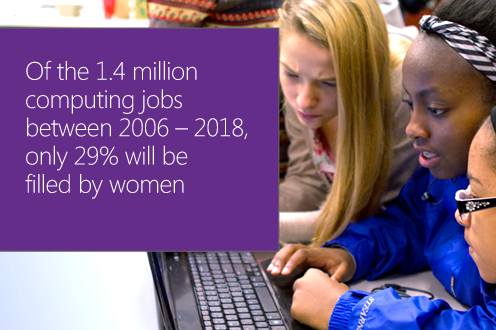
Although computer science is poised for exponential job growth over the next several years, there’s a glaring lack of women entering the field. Since 1984, the number of computer science degrees awarded to women has steadily declined, to the point where today only 13 percent of computer science graduates are female.

As I speak with young women around the world, I continue to find that their disinterest stems from a lack of familiarity with the exciting and impactful career possibilities in computing. The obvious remedy is to expose more young women to the professional opportunities in computer science. This has been my personal mission, and I am pleased to be surrounded by amazing young women who evangelize computer science as a field in which women can make their mark.

she++ logoOne such “evangelist” is Microsoft intern Ayna Agarwal, a student at Stanford University. In January 2012, Ayna co-founded she++, a community that seeks to inspire women’s involvement in computer science. she++ sponsored Stanford’s first conference on women in technology in April 2012, an event that attracted more than 250 attendees and hosted a lineup of inspirational women engineers, including employees of such Bay Area tech firms as Google, Facebook, Dropbox, and Pinterest. After positive feedback from attendees, mentors, and the press, the she++ conference has become an annual event at Stanford, one of many initiatives that she++ sponsors in its effort to create momentum for female technologists.

I was extremely excited to join with Ayna to co-host Reinventing Tech for the Next Generation—she++ and Microsoft Research, on August 28. This event featured two panels: the first comprised of female interns who are on the forefront of the next generation of computer scientists, and the second consisting of top technical women from Microsoft who are driving innovation and change across the company.

Katie Doran (far left) hosts the panel of interns: Ayna Agarwal, Priya Ganesan, and Amy Lin (pictured left to right) Katie Doran (far left) hosts the panel of interns: Ayna Agarwal, Amy Lin and Priya Ganesan (pictured left to right)

You can now view the event on-demand. And while you’re in video-watching mode, you might want to take a look at the she++ documentary video and the Microsoft Research Bridging the Gender Gap video, both of which highlight  efforts to increase the presence of women in computing. In addition, I encourage all you girls (and boys) to try out these free tools that can teach you how to program and help you explore computer science: Kodu, Microsoft .NET Gadgeteer, Pex for Fun, and TouchDevelop.

Rane Johnson-Stempson, Principal Research Director for Education, Microsoft Research Connections


I was extraordinarily excited to join forces with Microsoft Research to bring together generations of female programmers to share their stories, and I hope that the on-demand video of “Reinventing Tech for the Next Generation” will expose even more young women to the tremendous possibilities in computer science.

Pictured from left to right, Ayna Argarwal, Rane Johnson, and Katie Doran led the event, “Reinventing Tech for the Next Generation.” Rane joined the event virtually with the BEAM robot.  Pictured from left to right, Ayna Argarwal, Rane Johnson, and Katie Doran led the event, “Reinventing Tech for the Next Generation.” Rane joined the event virtually with the BEAM robot.

Three years ago, I entered Stanford as a dreamer, planning to change the face of global health through veterinarian medicine. However, I soon tired of the preparatory science classes and of feeling tethered to the vet hospital. I still wanted to have big impact on the world, but I wasn’t sure how.

Then I took my first computer science class and fell in love with the problem-solving mindset. Moreover, I soon realized that technology had the ability to touch the lives of millions, offering new communication and productivity tools and entertaining toys, serving as a means to unravel the biggest crimes, providing protection via mobile phones in developing countries—the possibilities are endless.

I became convinced that the full potential of tech is yet to be discovered. Yet a couple months prior to that first class, I had no idea that computer science was even a discipline, or that large companies and startups were built entirely around bringing technology to life. I had never even conceived of the possibilities.

I realized that my ignorance about computer science derived in large measure from the lack of role models sharing their stories. So I created she++ to be a community of voices of those technologists: the ones who are breaking the boundaries and incorporating their interests into the field.

she++ soon evolved into a personal mission to embolden and enrich the possibility of technology. I aim to provide an inspiration for all types of people, with every interest, encouraging them to take a peek and enroll in their first programming class. The future of the world lies in tech, and we need more people, with unique perspectives, than we’re training today to work in the industry. I hope that the joint Microsoft Research and she++ event entices girls everywhere to take their first programming class—and to realize they can have big impact in this world with technology.

—Ayna Agarwal, student at Stanford University and summer intern at Microsoft

Learn more

Fun with programming

Concussion puts making a difference on pause

Hi folks, it has been a longtime since I have posted a blog and been online due to a concussion I had on February 23, 2013. I would like to take the time to help people understand concussions better and they are not something to ignore!

As the typical Rane, who thinks she is a robot that is indestructible, I got up from the 2 foot diameter puddle of blood on my hardwood floor and begun to tell my husband everything is just fine at 2 in the morning, as he thought someone was breaking into our home and kicking down our back door from the loud boom of me hitting the floor.  He cleaned me up (thank you Greg) and as I ran to the toilet to hurl a few times, I tried to convince him I was fine and we should just go to bed.  After keeping me a wake for a long while and ensuring I was not going to go to sleep and never wake up.   (for those who do not know, if you go to sleep after a concussion you have a good chance of not waking up again, so don’t do it!) He finally let me go back to sleep and head to the emergency room in the morning.   In the morning, I was ready to ignore the hospital idea and  jump on another plane and fly off to go change the world and grow women computer scientists.  My husband forced me to slow down, head to the emergency room and ensure everything was okay before I take on my next activity.  There, I found out I needed 9 stitches and that I had a concussion and should stay home and not do anything for the next few days.   I did not realize the sensitivity of your brain and continued on as business as usual, ignoring the doctor.  DO NOT DO THIS FOLKS!!!  I ended up making myself worse and could have healed a lot faster if I would have listened to him in the first place.

 Women Hack to solve Human Trafficking issuesI raced to the airport and headed to our first ever International Women’s Hackathon being launched in 7 countries and 14 locations around the world.  (Thanks to my husband driving me, later I would find out that I would not be able to drive for five months due to my lack of balance, memory and vision.)   It was a fantastic hackathon with over 600 young women all over the world programming to make a difference in proactively helping victims of human trafficking.  I on the other hand was not doing well with blurred vision, massive migraine headache and coming close to blacking out a few times.  I continued to move forward and then head to the Michigan Women in Computing Conference where I was the keynote speaker.  When I got about half way across the United States, my brain felt like it was going to explode and about 100 knives were being stabbed in my head.  I arrived in not too good shape but was taken good care of by the Michigan State University Team (thanks Laurie Dillon).  I gave the keynote and then flew back to Bend, OR to go get a CT Scan and MRI.  I then found out I had post-concussive syndrome (PCS) and if you don’t listen to your body you can’t try to solve the world’s greatest problems in computing because you have to focus on your health.  I knew nothing about PCS.

Post-concussive syndrome (PCS) is a set of symptoms that continues for weeks, months or even a year or more post a concussion.  It is a mild form of traumatic brain injury resulting in migraine headaches, difficulty concentrating, chemical imbalances in the brain, vision challenges, emotional and behavioral issues.  There is no treatment for PCS symptoms can only be treated  by medications, physical, vision and behavioral therapy and time.  In my appointment with the doctor, I could not balance on one foot, I failed memory tests and I was in the most excruciating pain from a migraine headache.  I learned I would now need to stop working, no more television, no more smartphone, no more computer, no more reading, I couldn’t drive, no more wine, no more caffeine and that I MUST REST– no ands ifs or buts.  For the first week, I could do nothing but lay in bed and then the next five months would result in only walks with my dog, listening to books on CD and knitting.  I spent the next four months with a migraine headache 24 hours a day 7 days a week.   My vision tracking dropped to a level of an 8-year-old.   If I had listened to the doctor in the first place it could have resulted in only a few weeks of recovery instead of five months.  DO NOT IGNORE doctor’s advice when you have a concussion it is serious!

I then got to spent the next four months spending time with three different doctors to try and get back to normal.  Learn to mediate, relax and calm the mind- an impossible endeavor for a Type A person.  I was surprised to learn there is still so much we don’t know about concussions and a lot of it is still a guessing game.  It also made me realize how illogical we humans are when it comes to our brain.  When we break an arm and leg we know we must rest it, not use it and give it recovery time, but with our brains we don’t ever rest it.  When you hurt your brain it needs to rest.  Resting your brain means no visual stimulation, no mental stimulation, plenty of sleep and rest, meditation is critical and necessary to heal.  Learning to slow down was very difficult but critical for me to finally heal and be able to go back to work.  Once I could read again, a few interesting books and research I read that may be interest to you, to help you through the siiutation if you get a concussion:

So now that it is all said and done and I am back to work, what I am I doing to ensure I don’t re-injure myself or what have I learned from this experience that may help other TYPE As or folks who have a concussion?

  • When your body needs to rest, if you won’t rest, it will force you to rest.
  • Life is too short to ignore your health and if you’re not healthy you can’t solve all the world’s greatest problems.
  • Your brain needs the same respect, rest and support you give any body part you sprain or break.
  • You can’t ignore the importance of work-life balance.
  • Don’t put work, volunteerism before family because in the end all you have is your family! (Thank you Greg, Pam, Gordon, Anne and Claudia for helping me through the last 5 months!)
  • Your not as important as you think you are, the world will move on, work will get accomplished and people will get things to work even when you aren’t around.  (Thank you to my amazing co-workers who stepped up and took so much of my work on!)
  • What you think must get done yesterday, can wait till tomorrow, even a few months.
  • Sometimes working slow is much better than multi-tasking and working fast!  (READ THE SLOW FIX!)
  • Lastly, I have a three-legged stool.  One represents global impact, one represents local impact and the last my family and self.  They must be in balance or I will fall off the stool.  If projects, opportunities & relationships don’t keep the three legs in balance then I must learn to say NO when one leg begins to become too long.  You can’t have a leg too long or you will fall off your chair.  It’s okay to say no, sometimes it is even expected!

I am truly happy to be back and I hope you look forward to the many blogs to come this year as I continue my passion to grow more women in computing!  At the same time I hope this blog helps you to take time to stop and smell the roses and take care of yourselves as you go on and take on so many challenges in your lives.

Learn about the Microsoft Innovation Center

 
MISSION
To help organizations in the West Region reach their full potential by having a facility and partners to help them solve their greatest challenges.
 
GOAL
Help Oregon and the West Region build economic development through building student knowledge and empower local organizations to better utilize technology more succesfully.
 
SOME ACTIVITIES
We will organize events, seminars, workshops, and presentations that build practical knowledge of how the Microsoft platform and partners solutions help the community achieve its goals and drive new innovative solutions for the global economy.
Come visit us at 1900 Sw 4th Avenue, Portland, OR SUITE 150